Home
About Norwich
Our Team
Content
    All Articles
    Cover Story
    Animals Rule!
    Around Town
    Artist Profile
    Creating Community
    Elder Profile
    Green Page
    Goodness InDeed
    History
    Life at 531 Feet
    Meet your Neighbor
    School Days
    Your Green Spaces
Our Sponsors
Advertise
Archives
Contact Us

Norwich Times - Good People, Good Places, Good Things Happening
  • Home
  • About Norwich
  • Our Team
  • Content
    • All Articles
    • Cover Story
    • Animals Rule!
    • Around Town
    • Artist Profile
    • Creating Community
    • Elder Profile
    • Green Page
    • Goodness InDeed
    • History
    • Life at 531 Feet
    • Meet your Neighbor
    • School Days
    • Your Green Spaces
  • Our Sponsors
  • Advertise
  • Archives
  • Contact Us
All, Cover Story

“Being Merry in the Sunshine” Marion Cross School Celebrates Mayfest 2025

July 4, 2025 by Devin Gifford No Comments

Every year, on a Thursday in May, students of all ages at Marion Cross School gather on the Norwich Green to sing, dance, and welcome the sunshine. Community members join them on picnic blankets to enjoy live music performed by the school band and watch the students’ performances. Mayfest is a long-standing tradition at Marion Cross—a spring festival that has been celebrated for as long as many faculty members can remember.

Students look forward to performing all year long. In the weeks leading up to the festival, they spend lots of time outside practicing and perfecting the songs and dances specific to their grade level. They also create colorful garlands to wear and vibrant paper decorations to adorn the Green.

This is Travis Ramsey’s eleventh year teaching music to children from Pre-K through sixth grade at Marion Cross. He leads both the chorus and the band, and has been working hard to prepare students for Mayfest. “It’s a chance for the kids to come out and celebrate spring with singing and dancing,” Ramsey says.

The songs and choreography students learn for the festival vary based on their age and skill level. Much of the performance is rooted in tradition, with each grade typically participating in the same dances each year—drawing on New England’s rich history of folk music and dance. Contra dancing, for example, is a centuries-old folk tradition that remains popular in New England today. Accompanied by fiddle and accordion music, this communal dance involves long lines of dancers pairing up and moving in rhythmic patterns. It’s meant to be a shared experience, and Mayfest proudly upholds this spirit of togetherness as students sing and dance side by side.

Mia Tesone and Lucy Gaugh

Mia Tesone and Lucy Gaugh

The sixth graders, the oldest students at Marion Cross, cap off the festival with a series of maypole dances. A maypole dance is a traditional folk routine in which dancers move around a festively decorated pole, each holding a ribbon attached to the top. As they circle the pole, they weave intricate patterns with their ribbons. At the end of the dance, the ribbons are swiftly unwound in a dazzling swirl of color and movement. It’s a beautiful and symbolic way to welcome spring. Younger grades perform dances appropriate to their level, building up to the maypole dance in their final year at Marion Cross.

“The kids really look forward to being the biggest kids in the school and getting to perform this intricate maypole dance,” Ramsey explains. “It’s like a rite of passage.”

Georgia Gollub and Jaden Stocking

Georgia Gollub and Jaden Stocking

The long-standing tradition of Mayfest spans generations at Marion Cross School. Some current faculty members, who attended MCS as children, recall Mayfest with deep affection. Ross McGee, now a math coach at the school, is one such alum. He remembers feeling jealous of his older brother, who performed the maypole dance three years before he got his chance. “I eagerly awaited my turn to be a ‘big kid.’ The songs, the dancing, and being outside as an entire school community are memories I will always carry with me,” McGee says. The maypole dance gives students a joyful milestone to look forward to and fondly remember.

Hillary Roberts, a self-proclaimed “Marion Cross School Superfan,” was a classmate of McGee’s and now works as an education assistant at the school. She describes Mayfest as a tradition that makes Marion Cross “truly magical.” Like McGee, she recalls the 5th and 6th grade dances as highlights of her experience. “It was such an honor to finally be a fifth grader and wear all white with bells around our ankles while we did the ‘stick dance,’” Roberts shares. The stick dance, a beloved tradition for fifth graders at MCS, features students dancing and playfully jousting with poles.

The memories of Mayfest stay with Marion Cross students for decades. Ania Safford, a member of the class of 2000 and now a sixth-grade teacher at MCS, paints a vivid picture of her own Mayfest experience: “I can easily transport myself back to the meadow on a beautiful spring afternoon—the field filled with colorful flying flags, the sounds of accordion, fiddle, and guitar music, Maypole ribbons floating in the wind, and picnic blankets covering the hillside.” That tranquil joy is what alumni remember most dearly.

Mayfest offers students at Marion Cross a chance to learn traditional folk dances and perform them for their community on the spring Green, creating memories that last a lifetime. “The students get to put their teamwork and musical learning into action,” says Ramsey. “It’s an important way for us to contribute to our community.”

Share:
Reading time: 3 min
All, Cover Story

Skating in Norwich: A Community Effort, Then and Now

February 22, 2025 by Devin Gifford 1 Comment
The hosing team that helps keep the Norwich rink smooth and ready for skating all season long.

The ice rink in the center of the Norwich Green is up and running for another season of winter fun. The creation and upkeep of the rink has been a tradition of the community since at least the ’70s, though skating on the green has likely been a common winter activity for much longer. What started out as a single volunteer standing out on the green with a hose has transformed into a community effort that takes dozens of volunteers each season. Thanks to the tireless efforts of these volunteers, Norwich residents get to enjoy gathering at the rink to skate and socialize during these cold winter months. They call it a “special spot.”

“I used to plow it with my truck and was sometimes helped by one of Leonard Cook’s men,” says Norwich resident Milton Frye, who helped with the rink back when it started in the ’70s. “Volunteers helped me at night to flood the rink with fire hoses that we stored in the basement of the 1898 building.”

THEN: Skating on the town green in Norwich, circa 1940s. Photo by Collamer Abbott NOW: Skating Party in Norwich.

THEN: Skating on the town green in Norwich, circa 1940s. Photo by Collamer Abbott NOW: Skating Party in Norwich.

In the early years of the rink, there were no boards around its edges, “but there was always enough snow so that snow banks held the water,” Frye adds. “It seems like there was always a lot of snow. For a while the shape of the rink was an ‘L’ so that both hockey and free skating could take place at the same time.” Members of the community offered their help and talents (as they still do today): “At some time in the ’90s, Jeff Marshal took over the responsibilities of maintaining the rink. He even brought his own snow blower down to school,” Frye remembers. “Peter Anderson welded hockey nets,” and “Ceci Tseng, a teacher, had skates for everyone in kindergarten so that they had an early start on the ice. There were always skates for children to use.”

Norwich residents gather around the fi re pit at the annual
skating party.

“There were never any restrictions about skating because of temperature,” Frye adds. “-10° was never too cold.”

Brie Swenson, recreation director in Norwich, has been working with volunteers to support the creation of the rink over the past few years. Each year, Swenson coordinates with the “head hoser,” an affectionate nickname for the volunteer that leads the project, to get the rink operational before the holiday break, weather permitting. Swenson worked with this year’s head hoser, Buck Child, as well as a team of local volunteers, the Department of Public Works, and the Norwich Fire Department to get the rink set up just before the break began.

“It was magical. Christmas morning, the rink was completely full,” Swenson recalls. But how did the magic get made? Swenson, Child, and several devoted volunteers started by placing the boards which form the foundation of the rink. In previous years, the Department of Public Works has stored the large plastic tarp used to cover the rink, but the recreation department has recently constructed a shed on the green where the tarp will be stored going forward. Once the tarp is laid and secured, the Norwich Fire Department hooks up a hose to fill the man-made rink with 20,000 gallons of water. The creation of the rink is a true community event. Local children often gather to help and watch the rink be filled.

The Norwich Fire Department fi lls the rink with a fire hose.

The Norwich Fire Department fills the rink with a fire hose.

However, the effort doesn’t stop there. Once the rink is frozen, it is open to the community for use by the Marion Cross Elementary School, the recreation department, and the local community at large. As Swenson describes, “Every weekend that the rink is up, it’s full.” To ensure that the rink doesn’t deteriorate, a team of volunteers, coordinated by the head hoser, work to clear the rink after winter storms and hose the rink nightly. This maintenance helps keep it smooth and skateable for the community. Kristin Brown Close was the head hoser from 2016 until 2019. She started working on the rink when her children began playing hockey.

“It is such an amazing team of volunteers,” she says. In a typical year, there are between nine and 12 hosers who are each assigned days that they are responsible for shoveling, scraping, and hosing the rink. Temperatures need to be below freezing for the ice to freeze smoothly. The hose itself is attached to a faucet, which sprays a thin layer of water onto the ice, making each hoser a “human zamboni” of sorts. In the event of a snowstorm, all hosers, as well as community volunteers, will come out to clear the rink.

Volunteers set up boards to form the edges of the rink.

Volunteers set up boards to form the edges of the rink.

“People would just drop everything and come to clear the ice,” Close describes. The longevity of the rink is dependent on the weather, but it is usually operational from December through March. Volunteers break it down in April, once it is thawed. While the rink is up, it functions as a community space where Norwich residents can be together outside. In the long winter months, it’s important to have a place where people can gather and warm themselves with recreation and pleasant company. For eight years running, the recreation department has held a skating party. Hot chocolate is served around fire pits, and of course, everyone enjoys skating on the rink. “It’s a really fun gathering, every year,” Close says.

This year, the party was on Friday, January 24th, and the rink was alive with laughter and excitement. Norwich Farm Creamery provided the hot chocolate, and parents gathered around the fire pits while their children skated. The rink was bursting with a rainbow of multi-colored snowsuits. The recreation department provided skates to those who didn’t have their own. Norwich residents found warmth in gathering as a community.

Ultimately, the community-building fun that the rink provides would not be possible without the work of the hosers. As Close put it, “the most important thing was the spirit of the volunteers, and how fun it was to work together.” Current head hoser Buck Child got involved with the rink because he recognized its importance to the community. “The whole town, all ages and abilities, can come out to the rink and enjoy it,” he says.

Kristin Brown Close hoses the rink.

Kristin Brown Close hoses the rink.

Several community organizations support the rink as well. The Norwich Women’s Club and The Lions Club of Norwich helped fund the purchase of the liner and the maintenance equipment. Community members donate shovels. The recreation department has recently had solar overhead lights and blue underlighting installed for nighttime skating. The rink itself now glows Norwich blue.

The rink is a free and open-to-all recreational space, something that is hard to find in the winter. “It’s a space where people can gather, all winter long,” Child says. “You can be a toddler or a senior citizen. Everyone gets out there.”

Child worries for the future of the rink in the face of warming winters, with cold nights and warm days making upkeep of the rink increasingly difficult. However, the importance of the rink and the dedication of the team of volunteers ensures that this tradition will continue as long as it can. “It’s a great thing for the town, the community, and the school,” he says.

Child also has exciting plans for the rink in the coming years. He’d like to organize broomball and hockey tournaments on the ice, as well as coordinating with the recreation department and the Hopkins Center for the Arts to have figure skaters perform at the rink. First and foremost though, he’d like to get some benches around the rink for skaters to sit on while lacing up their skates.

Norwich schoolchildren help to move benches to the rink.

Norwich schoolchildren help to move benches to the rink.

With the support of the community, hosers work diligently to maintain the rink throughout the winter. They are united in a sense of purpose. “When everyone else is inside next to the fire with a cup of hot chocolate, they’re out there with a hose full of cold water, splashing it down on the ice,” Child explains.

While it is cold and laborious, the job is never thankless. “When you drive by and you see all these kids and adults having so much fun, it’s all worth it,” Kristin Close says. The rink is a labor of love that keeps the community connected even when the cold tries to drive everyone apart. As the side-by-side photos on the previous page depict, each winter for many years and more to come, a Norman Rockwell painting comes to life in the center of Norwich.

Share:
Reading time: 7 min
All, Miscellaneous

Looking to the Future by Preserving the Past: Norwich Volunteers Work Together to Restore Beaver Meadow Cemetery

November 25, 2024 by Devin Gifford No Comments

This past May, volunteers from the Norwich community came together to restore Beaver Meadow Cemetery. Under the guidance of the Vermont Old Cemetery Association (VOCA) and the Norwich Cemetery Commission, the restoration project succeeded in repairing, straightening, and cleaning monuments and headstones in the cemetery that had fallen into disrepair. This project exemplified the goals of both the Vermont Old Cemetery Association and the Norwich Cemetery Commission, two organizations working to preserve the history and legacy housed within Vermont cemeteries.

The Vermont Old Cemetery Association was established in 1958 by Professor Leon Dean of the University of Vermont. Originally, the association focused on restoring wooded cemeteries discovered by hunters in the area, but it has since expanded into a nonprofit that restores cemeteries all over the state from May to October. Communities can contact the VOCA and apply for grant funding to repair a cemetery in the area. The VOCA provides funding and instruction, and the community provides volunteers willing to work to restore and preserve the cemetery.

Tom Giffin, current president of the VOCA, has been a member since 1984, and he has since been a part of hundreds of community restorations. To him, the most rewarding part of the work is preserving the history imbued in these spaces: “You can’t talk about the history of the United States without talking about Vermont, and the people who made that history are buried in Vermont cemeteries.”

For each restoration project, the VOCA depends on volunteers from the communities in which they work. Through community outreach in the weeks leading up to a project, they generate anywhere from 30 to 100 volunteers willing to devote their time and effort to learn how to repair monuments and straighten and clean headstones. Volunteers come from all walks of life, and there are opportunities for people of every age and ability to pitch in. “If they can’t lift stones, they can clean stones. There’s always something for everyone to do,” Giffin explains.

The VOCA approached the Norwich Cemetery Commission regarding the Beaver Meadow project in late May. The Norwich Cemetery Commission is composed of four dedicated civil servants (Wilbert “Scooter” Hardy, Emily Myers, Bonnie Munday, and Dan Goulet) who meet to discuss concerns brought forth by the community about the condition of the local cemeteries. Issues include fallen trees and debris within the cemetery, headstones in need of repair, and full restoration projects like Beaver Meadow.

Emily Myers, voted onto the commission by the town in 2020, is passionate about preserving the history and legacy embodied by local cemeteries. “Preservation means helping to clean and maintain these headstones so that people can enjoy these spaces and learn about those who came before them,” Myers explains.

The Beaver Meadow project was initiated by several community members, including Donna Wheeler and Jane Keller, who brought the state of the cemetery to the attention of both the Norwich Cemetery Commission and the VOCA. With instruction from the VOCA and the help of more than 30 volunteers, the restoration project succeeded in repairing and restoring every damaged headstone in the cemetery.

“In Beaver Meadow, a bunch of stones were down, needed straightening, or needed repair, and before we left, everything in that cemetery was restored,” Giffin recalls.

This project would not have been possible without the effort of the tight-knit local community. Volunteers of all ages came from Essex and other nearby communities to pitch in. “There was a sense of purpose in coming together and helping to preserve this beautiful cemetery,” Myers says. Younger volunteers made the restoration possible despite the steep elevation of the cemetery, pushing wheelbarrows of Surepak gravel uphill.

“It was a great project in a quintessential Vermont cemetery,” Giffin says. “I mean, with a name like ‘Beaver Meadow’, you can’t get more Vermont than that.”

The project marks a success for both the Norwich Cemetery Commission and the VOCA. Both organizations aim to continue restoring Vermont cemeteries for generations to come. These cemeteries are spaces preserved by the community for the community, and the history within their grounds is part of the legacy of Norwich.

Looking to the future, the Norwich Cemetery Commission hopes to facilitate more community restoration projects like the one in Beaver Meadow. “I want to ensure that our cemeteries are places that people can walk, enjoy, and come together as a community to help preserve the history and the integrity of these spaces,” says Myers.

The VOCA remains true to their mission of restoring cemetery spaces to preserve Vermont history. The nonprofit has provided over $60,000 of grant funding to communities across Vermont, and plans to continue fundraising in order to provide larger grants to communities in the future. They aim to expand their membership, especially amongst the younger generation, and continue to demonstrate how much can be accomplished when a community gets to work.

“We are a grassroots Vermont association that does it all for the good of the community. All we ask is that the community provides a few shovels, volunteers, and a sense of humor,” Giffin says.

Share:
Reading time: 4 min
All, Goodness InDeed

20 Years of Providing Perishable Food to Upper Valley Residents In Need

by Devin Gifford No Comments
Norwich community members were welcomed into Willing Hands facilities during the celebration.

Willing Hands, a local nonprofit organization dedicated to ending food insecurity in the Upper Valley, celebrated their 20th anniversary on Thursday, October 10th. Since the organization was founded by Peter Phippen in 2004, the staff and volunteers of Willing Hands have worked to reduce food waste by redistributing perishable food to their 80 recipient organizations, including food shelves, shelters, and assisted living facilities. Willing Hands has made a significant impact on the Upper Valley over these past two decades, and they celebrated with an open house honoring the individuals that make this work possible.

Willing Hands Executive Director Gabe Zoerheide atthe 20th Anniversary celebration.

Willing Hands Executive Director Gabe Zoerheide at
the 20th Anniversary celebration.

Gabe Zoerheide became the executive director of Willing Hands in June of 2015, but he has lived in the Upper Valley most of his life, working for various nonprofit organizations. “Nonprofits are an essential part of the social safety net of our community,” Zoerheide explains.

Willing Hands in particular provides a safety net for those experiencing food insecurity in the Upper Valley by delivering perishable food items throughout the area for free. “Food should be a basic human right,” Zoerheide says, “and for a lot of folks in our community, there are financial barriers to access this basic human need.” By taking food that would otherwise be wasted and delivering it to those who need it, Willing Hands is benefitting both the Upper Valley community and the climate.

The organization collects food from a variety of sources: some is grown at their compound on Church Street, some is gleaned from local farms at harvest time, and a majority is donated from Hanover Co-op food stores and other large produce wholesalers. By redistributing this food, Willing Hands prevents 1.1 million pounds of carbon emissions per year, making them a carbon negative organization. The organization keeps careful track of their carbon balance through a climate action plan, measuring the carbon they emit through delivery and food storage and weighing it against the emissions that would have been caused by food waste.

“Reducing food waste is our core mission, and there is a significant carbon avoidance benefit to that,” Zoerheide says. Much of the food that Willing Hands redistributes would have gone to the landfill, and the energy used to produce that food would go to waste. When they receive donations, they sort the food to ensure its quality, store what they will use, and compost what they don’t use in order to fertilize their on-site gardens.

Donations from food distributors and local farms are only one way that the community supports the work of Willing Hands. “We exist because of the community. Without a community of volunteers, supporters, and leaders, our work just wouldn’t exist,” Zoerheide says. Willing Hands relies on hundreds of volunteers that continue showing up each year to grow food, sort food, and glean food. They are largely funded by community members who choose to invest in the work that they do.

As an organization battling food insecurity, the staff of Willing Hands wish that the issues they address no longer existed. “Celebrating that our work is still needed didn’t feel right,” Zoerheide says. So, when it came time to celebrate 20 years of Willing Hands, the organization chose to celebrate the people who make this work possible.

Norwich community members were welcomed intoWilling Hands facilities during the celebration.

Norwich community members were welcomed into
Willing Hands facilities during the celebration.

The celebration honored founder Peter Phippen, as well as long-standing board chair Jack Lyons, who passed away last spring. Willing Hands thanked Co-op food stores, their largest donor, and former general manager Terry Appleby, who was integral in establishing the lasting connection between Willing Hands and the Co-op. Current board members, staff, and volunteers were also celebrated. Zoerheide described it as a celebration of “the two decades of care that went into the founding, nurturing, and support of the organization.”

At the open house, the Norwich community had the opportunity to learn more about the inner workings and mission of the organization. Their strategic plan includes a focus on equitable distribution throughout the diverse communities of the Upper Valley, and the organization aims to continue making an impact in an inclusive way. “If you don’t carefully examine your actions with an equity lens, you have the potential of not being aware of communities in need or not seeing those who fall through the cracks,” Zoerheide says.

Looking to the future, Willings Hands hopes to continue to expand its operations, find more ways to prevent food waste, and serve the Upper Valley. Willing Hands is prepared to continue redistributing food to Upper Valley residents in need for at least another twenty years, as long as they are supported by the community. “One of the heartwarming things about nonprofits is that they exist because the community cares about them,” Zoerheide says, “And cares about each other.”

Share:
Reading time: 4 min
All, Cover Story

Norwich Resident Takes the Helm at VINS

August 26, 2024 by Devin Gifford No Comments

In April of this year, the Vermont Institute of Natural Science (VINS) welcomed a new executive director, Alden Smith. Having moved to Norwich in 2022, Smith has been working to be the leader that VINS needs, while he, his wife, Missy, and their three children continue to settle into their home on Church Street.

Smith directed the Mountain School of Milton Academy in Vershire for two decades, so he and his family have lived in the Upper Valley for a long time. Smith described Vershire as a “remote, beautiful place” and a wonderful community for his children. However, he and Missy made the decision to move to Norwich in order to give their children, who are now 9, 13 and 15 years old, closer access to their various passions. Whether it was piano lessons or soccer practice, the remote location of Vershire ultimately made it more difficult for them to commute their children to the many opportunities found in the Upper Valley.

Alden Smith and his family enjoying the Norwich Town Forest

Alden Smith and his family enjoying the Norwich Town Forest

When Smith left the Mountain School, he didn’t know what his next career step would be. They spent their first year living in Norwich, unsure of whether or not they would be able to stay, but that didn’t keep them from falling in love with the vibrant community. “We traveled and interviewed all over the east, looking for new jobs and places to live, and we never found anywhere as wonderful as the neighborhood we live in right now, in Norwich,” Smith explains.

They found their new community in Norwich to be an intersection of access to both the arts and the natural world. Smith and his family love the trails, the farmers’ market, the wildlife, and the walkable nature of Norwich. Smith recalls that “the first Halloween shocked and delighted us.” After living thirty minutes from the nearest stoplight in Vershire, moving to Church Street put the family smack in the middle of the Norwich community. He remembers the trick or treaters coming to his door in droves, and how wonderful it was to host guests and be welcomed into the neighborhood.

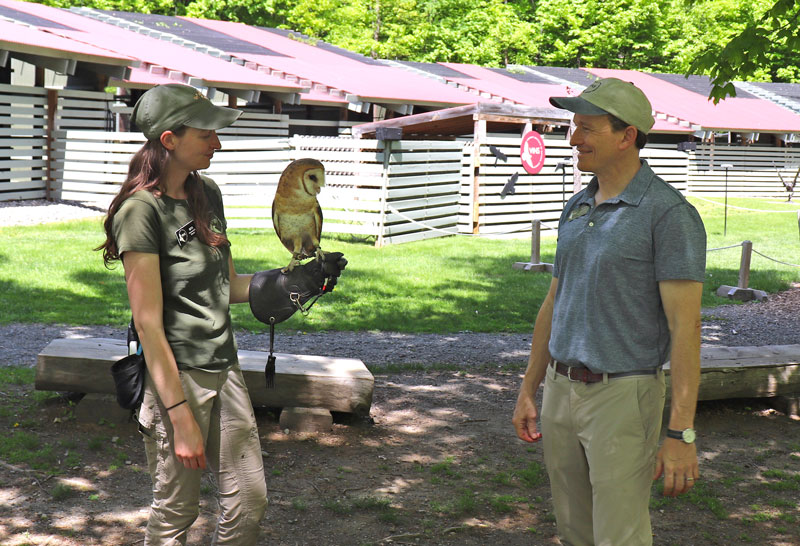
VINS executive director Alden Smith admires a barn owl perched on the arm of a handler.

VINS executive director Alden Smith admires a barn owl perched on the arm of a handler.

While Smith says the “walkable, bikeable access to community” was one of the highlights of his initial experience moving to Norwich, he also cited the connection to nature as part of the reason his family chose to make Norwich their home. He calls the slice of woods behind their home a “pocket of serenity.”

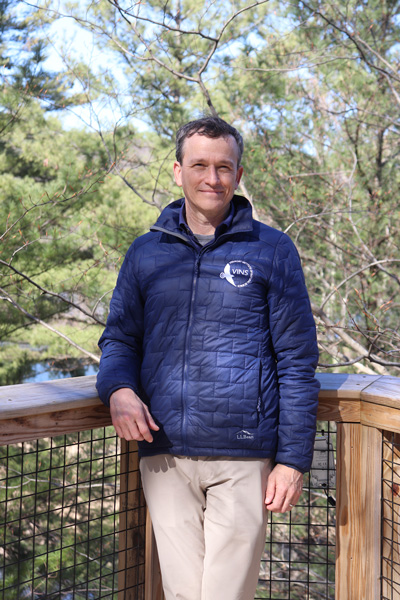
Norwich resident Alden Smith, the new Executive Director of the Vermont Institute of Natural Science.

Norwich resident Alden Smith, the new Executive
Director of the Vermont Institute of Natural Science.

“In some ways, it’s been surprising how many wild places exist down valley in Norwich, which I used to think of as a population center,” Smith says. While he misses the deep forests of Vershire, he’s finding that Norwich has more in common with his previous home than he had first thought. He and his family have been enjoying harvesting mushrooms, hiking, and biking in the woods so far over the past two years.

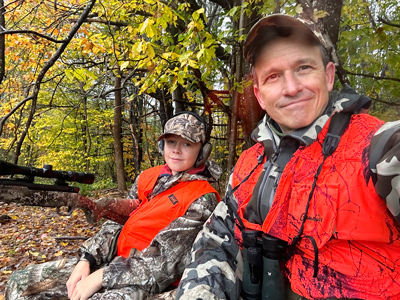
Smith also enjoys bow hunting, which has been one way that he’s gotten familiar with the woods of Norwich since moving here. He acknowledged that being a hunter might seem to be in tension with his conservation work at VINS, but he views his hunting as a conservation effort in itself: “While Norwich is diverse and healthy, an overpopulation of deer is not good for biodiversity.”

So, despite their extensive job search, the Smith family hoped a job opportunity would emerge in the Upper Valley. Smith’s position at VINS provided a perfect opportunity for them to stay in Norwich.

Smith has been settling in well as the new executive director of VINS, applying the nonprofit management skills he learned at the Mountain School – a semester program for juniors located on a farm with a focus on connecting to nature and to each other. He was drawn to VINS by its mission to inspire people to care for the natural world. Living and promoting this mission, he says, requires simply that he be the “most authentic version” of himself.

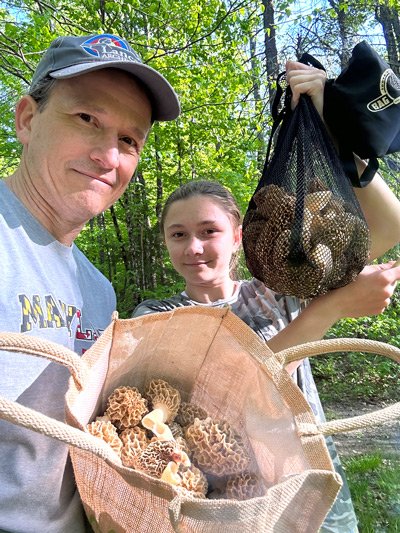
Alden and his daughter Ellicott harvest morel mushrooms in the Upper Valley woods

Alden and his daughter Ellicott harvest morel mushrooms in the
Upper Valley woods

He finds the work fun and restorative. “Even if I’m having a bad day in the office, I can go visit the snowy owls or climb the canopy tower and look out on the Ottauquechee River,” he explains. For Smith, VINS is an extraordinary place to work and learn, and he feels lucky to have found his “work home” there.

While his long-term goal is to expand the impact that VINS has in the community, Smith remarked that he’s taking it slow and learning from all that VINS has to offer. “Right now, we are launching a strategic planning process that taps into deep wisdom within the organization,” he says. The next steps that Smith envisions for VINS hearken back to its origin story: in 1970, VINS founders David and Sally Laughlin led an effort to clean up the then-polluted Ottauquechee River and continued their conservation efforts from there, resulting in the creation of VINS in 1972. “We’re really interested in circling back to that original vision, especially the ways that clean water connects and heals us,” Smith says.

Smith thinks of this story each time he climbs to the top of the canopy tower. “I look down at the Ottauquechee River, which is about two football fields away and 100 feet below, and I can see down through that clean river to the stones at the bottom,” he explains. Smith views this clarity of water both as a testament to the Laughlins’ vision and as a call to continue the effort to heal and protect the Upper Valley.

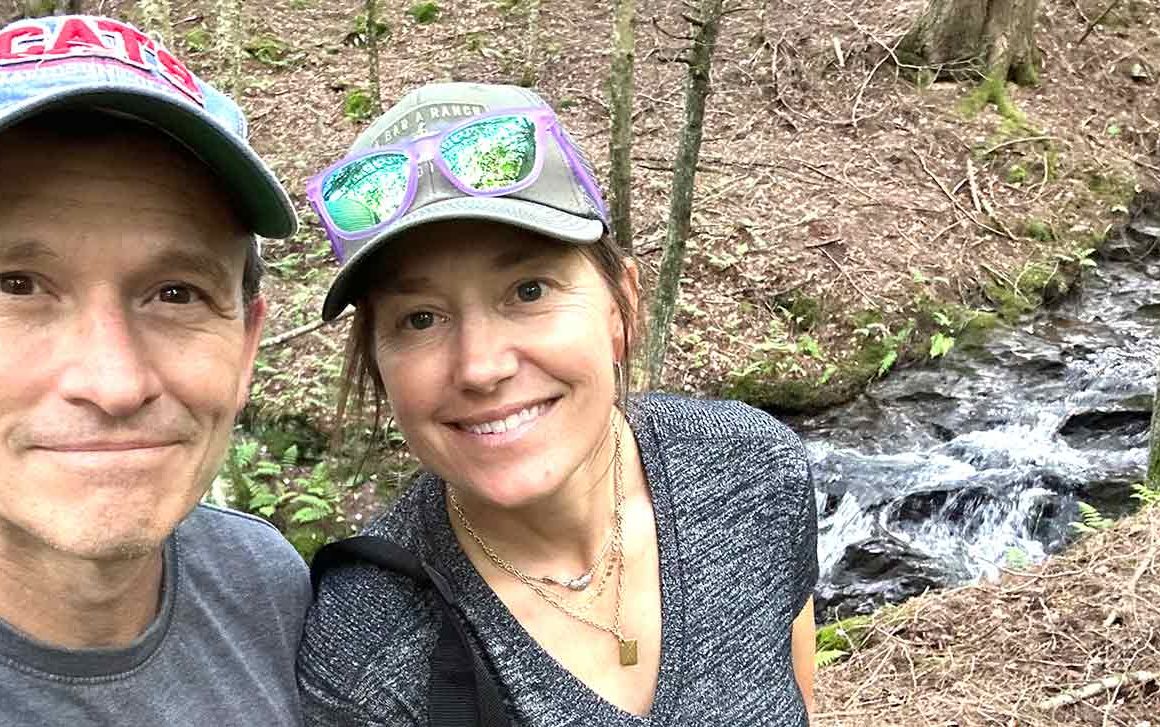
Alden and his son, Alden Hopkins, in the Norwich woods on Youth Hunting Weekend

Alden and his son, Alden Hopkins, in the Norwich woods on
Youth Hunting Weekend

So Smith’s priority is to apply the rich history of VINS to the needs of the present. “We give people an opportunity to see what is present but often invisible in nature,” he says. From locking eyes with a Golden Eagle to walking through the top of the tree canopy, visitors discover unique perspectives on the natural world. Smith hopes that the community is inspired by these experiences to take action and protect the environment. He acknowledges that VINS would not exist without the community. VINS is supported by a devoted group of volunteers, many of whom have been with VINS for decades, and the institute welcomes new volunteers every year. Local schools and camps visit VINS, giving them the opportunity to educate young people, and the nonprofit relies on funding from many people and organizations throughout the Upper Valley.

“We’re grateful at VINS to do the work we do, and to help the Upper Valley be a healthier place to live and learn,” Smith says.

Share:
Reading time: 5 min

Our Latest Issue

Fall 2026 Edition

© 2024 copyright Greater Good Media. All rights reserved.