

Norwich Resident Takes the Helm at VINS
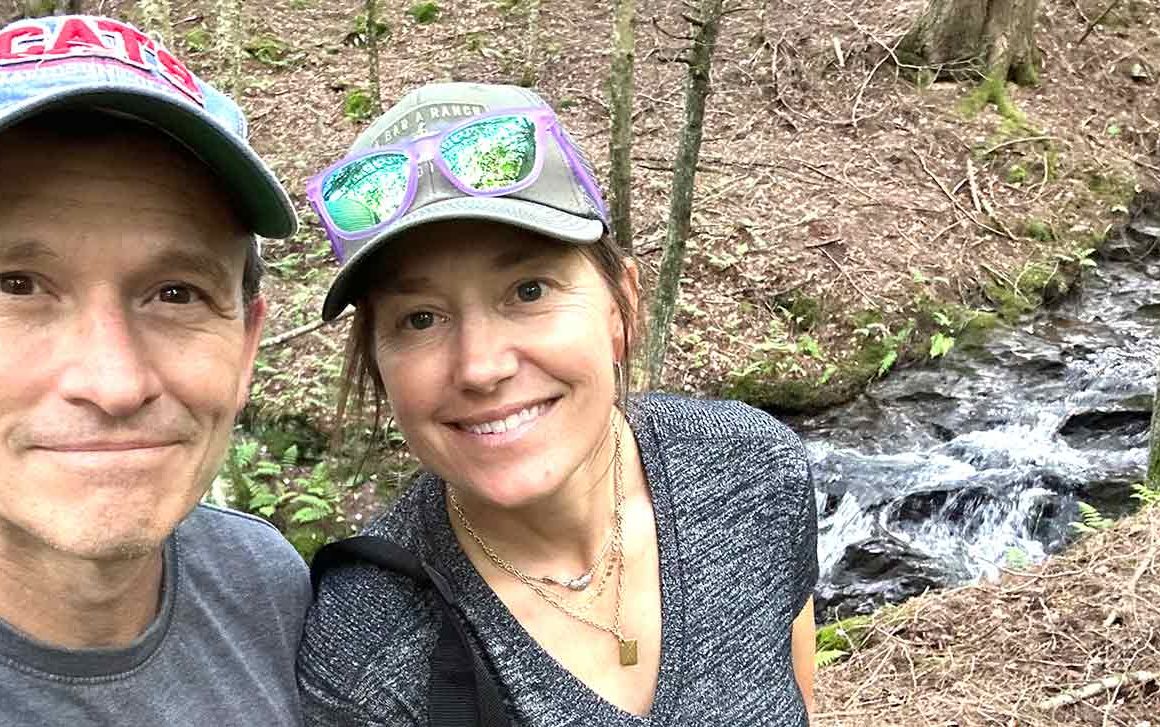
In April of this year, the Vermont Institute of Natural Science (VINS) welcomed a new executive director, Alden Smith. Having moved to Norwich in 2022, Smith has been working to be the leader that VINS needs, while he, his wife, Missy, and their three children continue to settle into their home on Church Street.
Smith directed the Mountain School of Milton Academy in Vershire for two decades, so he and his family have lived in the Upper Valley for a long time. Smith described Vershire as a “remote, beautiful place” and a wonderful community for his children. However, he and Missy made the decision to move to Norwich in order to give their children, who are now 9, 13 and 15 years old, closer access to their various passions. Whether it was piano lessons or soccer practice, the remote location of Vershire ultimately made it more difficult for them to commute their children to the many opportunities found in the Upper Valley.

Alden Smith and his family enjoying the Norwich Town Forest
When Smith left the Mountain School, he didn’t know what his next career step would be. They spent their first year living in Norwich, unsure of whether or not they would be able to stay, but that didn’t keep them from falling in love with the vibrant community. “We traveled and interviewed all over the east, looking for new jobs and places to live, and we never found anywhere as wonderful as the neighborhood we live in right now, in Norwich,” Smith explains.
They found their new community in Norwich to be an intersection of access to both the arts and the natural world. Smith and his family love the trails, the farmers’ market, the wildlife, and the walkable nature of Norwich. Smith recalls that “the first Halloween shocked and delighted us.” After living thirty minutes from the nearest stoplight in Vershire, moving to Church Street put the family smack in the middle of the Norwich community. He remembers the trick or treaters coming to his door in droves, and how wonderful it was to host guests and be welcomed into the neighborhood.
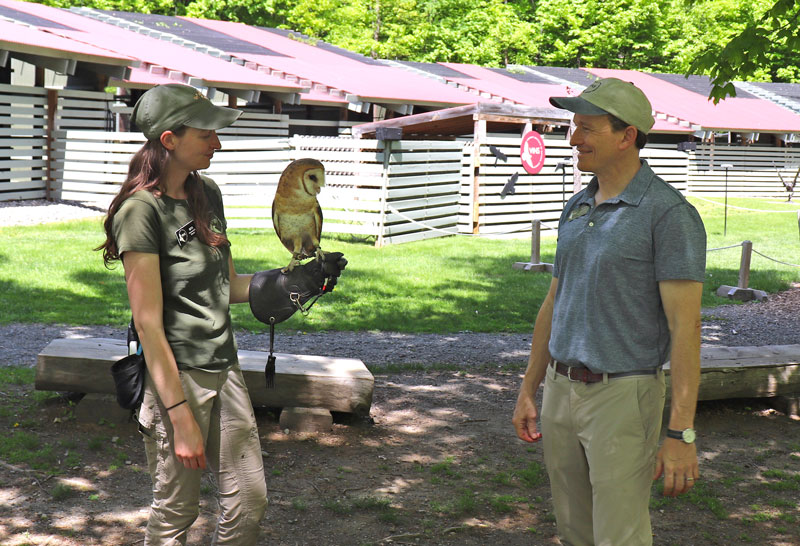
VINS executive director Alden Smith admires a barn owl perched on the arm of a handler.
While Smith says the “walkable, bikeable access to community” was one of the highlights of his initial experience moving to Norwich, he also cited the connection to nature as part of the reason his family chose to make Norwich their home. He calls the slice of woods behind their home a “pocket of serenity.”
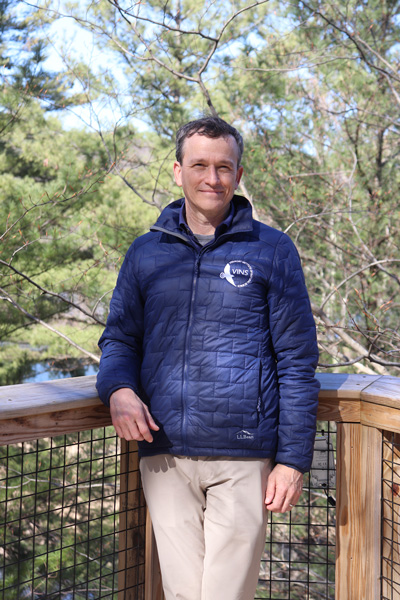
Norwich resident Alden Smith, the new Executive
Director of the Vermont Institute of Natural Science.
“In some ways, it’s been surprising how many wild places exist down valley in Norwich, which I used to think of as a population center,” Smith says. While he misses the deep forests of Vershire, he’s finding that Norwich has more in common with his previous home than he had first thought. He and his family have been enjoying harvesting mushrooms, hiking, and biking in the woods so far over the past two years.
Smith also enjoys bow hunting, which has been one way that he’s gotten familiar with the woods of Norwich since moving here. He acknowledged that being a hunter might seem to be in tension with his conservation work at VINS, but he views his hunting as a conservation effort in itself: “While Norwich is diverse and healthy, an overpopulation of deer is not good for biodiversity.”
So, despite their extensive job search, the Smith family hoped a job opportunity would emerge in the Upper Valley. Smith’s position at VINS provided a perfect opportunity for them to stay in Norwich.
Smith has been settling in well as the new executive director of VINS, applying the nonprofit management skills he learned at the Mountain School – a semester program for juniors located on a farm with a focus on connecting to nature and to each other. He was drawn to VINS by its mission to inspire people to care for the natural world. Living and promoting this mission, he says, requires simply that he be the “most authentic version” of himself.
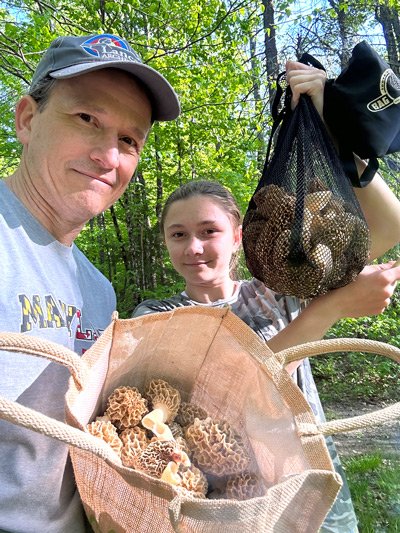
Alden and his daughter Ellicott harvest morel mushrooms in the
Upper Valley woods
He finds the work fun and restorative. “Even if I’m having a bad day in the office, I can go visit the snowy owls or climb the canopy tower and look out on the Ottauquechee River,” he explains. For Smith, VINS is an extraordinary place to work and learn, and he feels lucky to have found his “work home” there.
While his long-term goal is to expand the impact that VINS has in the community, Smith remarked that he’s taking it slow and learning from all that VINS has to offer. “Right now, we are launching a strategic planning process that taps into deep wisdom within the organization,” he says. The next steps that Smith envisions for VINS hearken back to its origin story: in 1970, VINS founders David and Sally Laughlin led an effort to clean up the then-polluted Ottauquechee River and continued their conservation efforts from there, resulting in the creation of VINS in 1972. “We’re really interested in circling back to that original vision, especially the ways that clean water connects and heals us,” Smith says.
Smith thinks of this story each time he climbs to the top of the canopy tower. “I look down at the Ottauquechee River, which is about two football fields away and 100 feet below, and I can see down through that clean river to the stones at the bottom,” he explains. Smith views this clarity of water both as a testament to the Laughlins’ vision and as a call to continue the effort to heal and protect the Upper Valley.
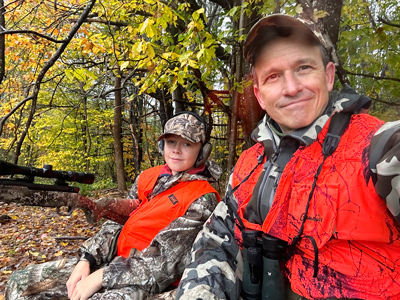
Alden and his son, Alden Hopkins, in the Norwich woods on
Youth Hunting Weekend
So Smith’s priority is to apply the rich history of VINS to the needs of the present. “We give people an opportunity to see what is present but often invisible in nature,” he says. From locking eyes with a Golden Eagle to walking through the top of the tree canopy, visitors discover unique perspectives on the natural world. Smith hopes that the community is inspired by these experiences to take action and protect the environment. He acknowledges that VINS would not exist without the community. VINS is supported by a devoted group of volunteers, many of whom have been with VINS for decades, and the institute welcomes new volunteers every year. Local schools and camps visit VINS, giving them the opportunity to educate young people, and the nonprofit relies on funding from many people and organizations throughout the Upper Valley.
“We’re grateful at VINS to do the work we do, and to help the Upper Valley be a healthier place to live and learn,” Smith says.


Leave a Comment