Home
About Norwich
Our Team
Content
    All Articles
    Cover Story
    Animals Rule!
    Around Town
    Artist Profile
    Creating Community
    Elder Profile
    Green Page
    Goodness InDeed
    History
    Life at 531 Feet
    Meet your Neighbor
    School Days
    Your Green Spaces
Our Sponsors
Advertise
Archives
Contact Us

Norwich Times - Good People, Good Places, Good Things Happening
  • Home
  • About Norwich
  • Our Team
  • Content
    • All Articles
    • Cover Story
    • Animals Rule!
    • Around Town
    • Artist Profile
    • Creating Community
    • Elder Profile
    • Green Page
    • Goodness InDeed
    • History
    • Life at 531 Feet
    • Meet your Neighbor
    • School Days
    • Your Green Spaces
  • Our Sponsors
  • Advertise
  • Archives
  • Contact Us
All, Miscellaneous

Rumble Strip: A Podcast for Our Time

February 22, 2025 by Cindy Heath No Comments

In traffic engineering, a rumble strip keeps us from going out of our lane or off the side of the road while we inadvertently catch a few winks. Newer cars have ‘virtual’ rumble strips, beeping loudly at our various driving mishaps like crossing a double yellow line or getting too close to another car. But unlike roadway rumble strips, Erica Heilman, producer of the Vermont-based podcast Rumble Strip, relishes getting up close and personal with the people she interviews. In a talk sponsored by VT Humanities that Erica gave at the Norwich Public Library last fall to a standing-room-only crowd, she shared her insights about the journey we humans are on together as we navigate life’s ups and downs, sometimes with guardrails on our emotions, but more often without. A fitting analogy, as it turns out, to the many alternative names for a rumble strip, and come to think of it, the ebb and flow of small town life – “sleepy bumps”, “wake up calls”, “growlers”, and “waker-uppers”.

Recognized as one of the top podcasts in the country by the New York Times and The New Yorker, and winner of a prestigious Peabody Award for “excellence in quality storytelling,” Erica has found a way for Rumble Strip stories to resonate with both listeners and reviewers. Erica explained her ultimate goal to the Norwich Public Library audience: “I want to make shows that remind us of this really natural capacity that we have to fall in love with each other and to join with something that’s bigger than ourselves,” she says. “I think if we bring this attention, openness, curiosity, and levity to our interactions with people, our communities will be stronger.” This sentiment was echoed by a Norwich resident who responded to a survey about the event. “Erica is my favorite podcaster and she is an inspiration to be curious and thoughtful about interacting with others in town. She is also an inspiration to become more involved in town.” And ‘becoming more involved in town’, whether in governance work, community events, supporting schools, or even just buying local first, all have a place in helping a community thrive.

Erica Heilman recording an interview for her podcast, Rumble-Strip, after Vermont's flooding last summer.

Erica Heilman recording an interview for her podcast,
Rumble-Strip, after Vermont’s flooding last summer.

In a follow-up interview after the event, Erica calls out the concept of Town Meeting day in Vermont, with its broad cross section of residents coming together to make decisions. “Town meeting is one of the last places where you gather together with people who are not like you. There are people you like and people you don’t like,” she says. “I am amazed every year at the civility of those meetings. There’s a kind of mutual respect that happens.” Town Meeting in Norwich is generally a civil affair, according to Selectboard member Mary Layton. “We vote by Australian ballot and have an information meeting the night before the Town Meeting. People come because it’s a town ritual, kind of marking the year like making maple syrup or planting your seeds,” she says. Mary observes that Norwich has a lot of voter participation, and that people pay attention to Town government. The Selectboard is discussing how to reshape the information meeting to include pie or maybe lunch so people can just talk among themselves about a particular issue. “People feel comfortable talking with the Selectboard members at community gatherings,” Mary says. “If they have something to say, they say it. Most of them say it respectfully, sometimes not.”

In listening to some of the more than 200 episodes of the Rumble Strip podcast, love and levity emerge as common themes, but heartache and tragedy have their place as well, often centered around the idea of building community. Erica continues, “Now that I’m old, I realize that the quality of my interactions with other people is a huge part of the quality of my life.” Erica’s warm and compassionate interviewing style clearly puts the people she speaks with at ease. But she is also a refreshingly bold questioner, tackling difficult topics like suicide, drug addiction, and other impactful life experiences that threaten to shatter us to the core, alongside uplifting topics like gardening, whale songs, little league, and puppies.

In playing back one episode, Erica spoke with a victim of last summer’s floods who lost her home in Plainfield, VT, and invites the woman to tell her story of being rescued. The recording was a vivid description of the rocks and water banging against the door, watching the water rise in the house, and the heart-wrenching moment when she had to choose between her own life and going back for her cat. Yet when the woman shared a personal viewpoint on the housing crisis in Vermont, one listener took exception to it, despite the tragedy of the woman’s circumstances. Erica points to this exchange as an example of people experiencing each other as ideologies and not as people, which is one of the more challenging aspects of humanity she’s working to shine a light on in her podcast.

Another survey respondent from White River Junction reflected on Erica’s talk: “We want to be heard, but do we want to hear? Maybe hearing and being heard are closer than we think. I was inspired to continue to hope to find a sense of authenticity and community, two concepts that join together in tandem with how people connect.” Erica laments there is a lot of life that doesn’t happen in-person anymore, especially with the decline in small general stores, local schools becoming regionalized, and fewer community gathering events. “There are fewer and fewer excuses to get together with people who are unlike ourselves – school plays, pie suppers,” she says. “We need places to run into each other to grow social capital and familiarity with each other and have a good time in town.”

Norwich Library director, Lucinda Walker, notes that Norwich has many important annual events that provide an access point for meeting people. “Norwich has a robust recreation department and a historical society that collaborates with the school on programs,” she says. The annual Lions Club Fair and Christmas pageant attract diverse crowds as well, and Norwich residents view activities for people to gather as a high priority. Lucinda sees the library serving as a “third space” – not work, not school, but a place where people of all ages can access information and see other people. Lucinda says that it’s taken a long time for people to return following the pandemic, but now they are back in droves, and the library remains a place where people can connect with their community.

The first episode of Erica’s independent podcast aired in 2013, before the word ‘podcast’ was mainstream. “Colin McCaffrey Talks Shop” was an engaging piece featuring the prolific Vermont-born singer/songwriter. In her introduction, Erica explains that on the show, she’ll be talking with “central Vermonters who are artists, road commissioners, waitresses, parole officers, teachers, and parolees,”  and that it will “feature what I hope is some good conversation, as well as what I hope will be some good conversational experiments.”

As the show has evolved over more than a decade, so has Erica’s understanding and appreciation for what it brings to her world and the world at large. “At a certain point, this show became something that marks time for me,” she says. “It’s the way that I understand and make sense of things, and make sense of this place where I live.”

As to the production aspects of the show, Erica speaks to the unique nature of an audio recording versus a written piece. “Audio is content but also dynamic and sound. What you can capture in audio is silence and tone. You don’t have to describe it because you can hear it,” she says. Erica goes into each episode entirely without a plan, preferring to allow the recording to dictate the final outcome. “Every single time I make a show, I don’t know what I’m doing or what it’s going to become. That’s another benefit of being independent and downwardly mobile. I just wanted to get going and get started. It has become what it is over the years, but each story dictates its format.” For a show with virtually no rules, there is one thing Erica is committed to in producing the podcast: “If I had a rule, it would be that I’d never want to put out a show where we were looking at someone rather than climbing in with them.”

Author Jeff Sharlet, of Norwich, attended Erica’s talk and knows her personally. “She’s a podcaster’s podcaster, a documentary artist’s documentary artist – someone to whom other practitioners tune in to hear how it’s done, how it could be done. And the great thing is, lots of everyday people do tune in as well,” he says. “I think listening to Rumble Strip makes us all practitioners. When we listen, we linger with other people in their lives. Listening makes us think like a documentary artist; it makes us listen to our own lives, too, and the other people with whom we share them, for better and worse.”

To decide on topics for the show, Erica looks to her own questions about life and living as well as getting ideas from listeners and friends. “Sometimes, I have a selfish and burning question about my age or dying, and then I’ll figure out how I will answer it or who I should talk to,” she says. “When you have a show that is a container that you can put anything in, it gives you a sense of freedom to explore.” Topics that come up frequently include death, love, hunting, farming, and lately questions of class and cultural blindness in Vermont. “I think we’re getting better at talking about race and gender, but not socioeconomic and cultural diversity. That’s a blind spot in both the media and in people’s minds,” Erica says. Lucinda appreciates the unfiltered view of Vermont life in Erica’s podcasts. “The thing I love about Erica and Rumble Strip is that she is giving us access to an authentic view of Vermont – the people who are populating our state and their experiences of living here, which counteracts the image of life here being bucolic all the time. We suffer like people do in other places,” she says.

“We have a lot of people coming to Vermont now, and that’s great, but it’s happening at a time that the nature of the towns are changing,” Erica says. “There are a lot of people doing good work in Vermont and there are cultural traditions here that are fading because of the changes in the way that we work and live.”

Erica likes to talk with people who are passionate about something rather than those who think they are certain about what’s right or wrong. “I don’t trust people who think they have a fix on the truth. I’m more interested in first person experience and what someone might be confused about,” she says. Erica has interviewed experts on childhood, a biologist who researches whale language (definitely worth listening to), and musicians, felons, taxidermists, teachers, and poets. “What surprises me after doing this for a while is how easy it is to fall in love with strangers. We are good at that, that’s our nature. It’s an important skill that we have as humans. It’s the best job in the world to be reminded of that daily. You don’t have to like everybody, but loving people is what we’re good at.”

Erica hopes Rumble Strip encourages listeners to fall in love with strangers and to find themselves in the lives of people who are unlike themselves. “It’s really important to show how extraordinary our tiny, ordinary lives really are,” she says. In the meantime, we’ll all just keep trying to stay on the road.

To explore the Rumble Strip podcast, visit rumblestripvermont.com.

Share:
Reading time: 10 min
All, Cover Story

How Sweet It Is

March 13, 2024 by Cindy Heath No Comments
How Sweet It Is - two kids in front of sap bucket

Historical accounts from early New England settlers describe the art of maple sugaring by the Abenaki and Wabanaki Indians as early as the 1500s, according to research compiled by the Nulhegan Abenaki Historical and Cultural Preservation Department. But before this, legends and stories passed down from the Abenaki, Wabanaki, and other Native peoples suggest that boiling sap to make granulated sugar for seasoning meats and vegetables, as well as for medicinal purposes, was taking place for many generations before the Europeans came to the New World.

According to the Massachusetts Maple Sugar Producers Association, there are many Native American legends about how maple sugar was first discovered: “One Iroquois legend tells how Chief Woksis had thrown his tomahawk into a maple tree one late winter evening. After he removed it the following morning, the weather turned sunny and warm. Sap began to flow from the cut in the tree, and drip down into a container at the base of the tree. The sap was used to boil the meat for dinner. As the water in the sap boiled away, a sweet maple taste was left with the meat.”

How Sweet It Is - man in sugarhouse with wreath above door
Reid Burris boiling sap inside the Delucia/Gardener sugar house

From early sap buckets made of birch bark to traditional metal spouts and pans, and to today’s plastic sap lines and reverse osmosis technology (removing much of the water from the sap before boiling), maple sugaring has undergone a slow but steady transformation throughout its history. Yet many family farm producers still collect sap in traditional metal buckets and gather annually around the boiling pan inside the sugar house. Some maintain that sap from the honored sugar maple tree boiled down the old fashioned way over a wood fire yields a more flavorful result and inspires an enduring sense of community. One Norwich resident, Graham Webster, is a long-time maple sugar maker using traditional methods with his grandmother’s boiling pan, which was passed down from his uncle. “I prefer the old school method and smoky flavor of maple syrup made over a wood fire, but the syrup still tastes great either way,” says Graham, who produces about 50 gallons of syrup a year to give away.

Commercially, Vermont produces the most maple syrup in the United States by far, reporting two million gallons in 2023, which is roughly 50% of the total produced nationwide according to the Vermont Maple Sugar Makers’ Association. With the benefit of ideal climate conditions, thousands of acres of sugar maple trees, and a rich tradition of maple sugaring, Vermont’s maple syrup industry is a vital part of the state’s economy as well as a rich family and community tradition.

How Sweet It Is - family standing in front of tree with sap bucket
The Van Arman Family at their family farm in Norwich: Tom Van Arman, Emily Myers, Deb Van Arman, Jay Van Arman, Eva Van Arman.

For Emily Myers and her family, producing maple syrup is now a fifth generation family activity. Emily learned to tap trees and boil sap from her parents, Deb & Jay Van Arman, on the family farm where she now resides in Norwich. Before that, Deb and Jay maintained the tradition begun by Deb’s grandparents, running their home sugaring operation for 18 years in the old sugar house near Union Village Road. “It’s been a family operation for five generations,” says Deb. “We’re so pleased that Emily and her family do everything together and that the kids are just as involved as their parents.”

How Sweet It Is - draft horse team in front of red barn
The old draft team, Queenie and Babe,
that carried sap on Deb & Jay’s farm.

Deb and Jay acknowledge that maple sugaring has changed quite a bit over the years. Deb recalls everything being done by hand – drilling the trees, installing metal taps, gathering the sap from the buckets into a metal tank. “I lived with my paternal grandfather, my parents, and my brother, and we had a sugarbush in the woods. We accessed it with our beloved draft horses, Babe and Queenie, pulling a sleigh with a big gathering tank, then we walked to the woods to gather the sap from the really old maples.” Back then, boiling was done outdoors in anarch (wood fired boiling structure), going well into the night. Deb notes that sugaring was important during the depression and World War II because of a sugar shortage, and with no farming to be had in the winter, boiling sap for a reliable source of sugar was common.

How Sweet It Is - woman testing sap in sugar house
Norwich local Lisa Gardener testing to see if syrup is ready to draw off.

Eventually, Deb’s father built a sugar house on the 116 acre family farm and sugaring continued into the ’80s. “The camaraderie was out of this world,” recalls Jay. “The old sugarhouse didn’t have electricity, but we had a lantern and we loved to cook eggs in the boiling sap.” Deb favors using sap and syrup in a variety of ways. “Using sap is a great way to cook a ham because it really enhances the flavor, and maple syrup has a greater nutritive value than refined sugar.” Indeed, modern analysis shows that maple syrup contains several important minerals and a few vitamins, and new research is discovering that it may have antioxidant and anti-inflammatory properties. Other traditional uses of maple syrup include flavoring coffee, sugar on snow, donuts dipped in syrup, and making maple candies, maple butter, and maple cream. Who knew something so delicious could be so good for you?

The family shifted to transporting the sap to Etna after state regulations required upgraded boiling pans, but eventually returned the boiling activities to Norwich. When their neighbors Dave Delucia and Lisa Gardner built a new sugarhouse with a wood fired stove, Jay introduced Dave and Lisa to the fun of maple sugaring, and they began boiling together. Even though Emily now carries on the family tradition with Dave, Deb and Jay still help out from time to time. “There’s a mystique about it,” says Deb. “You’re surrounded by steam, Dave serves up beans and franks around the arch, and it energizes you because you know that spring is coming.” For his part, Dave enjoys the social aspect.“ We get help from lots of friends and neighbors and people enjoy participating in the tradition. All together, we make about 50 gallons of syrup a year to give away to family and friends who help make it.”

How Sweet It Is - boy holding up sap bucket to maple tree
Jack Myers hanging a sap bucket during sugaring season in Norwich.

Emily has many fond memories of maple sugaring from her childhood that inspired her to carry on the tradition with her own family, including her teenage son and daughter. “March was always maple sugaring season and family members from around the country came to Norwich to boil. I wanted our kids to learn the values of hard work, community, bringing people together, and seeing what nature has to offer.” Emily’s son and a friend handled the important step of tapping the trees recently. “It’s nice to know that they are mature enough to understand how everything works and to see the full cycle of tapping, boiling, and eating the syrup on pancakes. It’s definitely a proud parent moment to think about passing the torch to the next generation.”

From the Native American tradition of generations past to today’s modern families, maple sugaring continues to bring people together to celebrate community and the wonderful bounty of the sugar maple tree.

Share:
Reading time: 6 min
All, Cover Story

The Legacy of the Norwich Lions Club

December 6, 2023 by Cindy Heath No Comments

From its founding in 1917 in Chicago to today, Lions Club International continues to be one of the world’s largest service organizations with more than 1.4 million members worldwide. In Norwich, the Lions motto, “We Serve”, is the guiding principle for the Club’s many initiatives focused on improving vision, hunger, global relations, pediatric cancer, and the environment. The wide array of community activities over the history of the Norwich Lions Club is remarkable. For a relatively small group, the Club has had a hand in supporting or improving nearly every aspect of the town including schools, non-profits, and town infrastructure and recreation facilities. Most recently, the Club was involved in screening elementary school children in Norwich, Sharon, and Woodstock for eyesight issues.

Chartered in 1954, the Norwich Lions Club (NLC) has served Norwich and the surrounding communities for nearly 70 years and conducts large and small fundraisers to support community projects initiated by its members as well as non-profit organizations throughout the Upper Valley. The Club’s first service projects included the donation of a piano to the Marion Cross School, the construction of a house at Beaver Meadow, and the development of baseball diamonds in town.

Phil Wheeler – a long-time Lion of 60 years, past Club president, and past district governor overseeing all Vermont clubs – was an early founder of one of the club’s most popular projects: the Memory Tree. “I started my Lions service with the Middlebury Lions Club but moved to Norwich after graduating from the Tuck School. When the Memory Tree project first started, I encouraged clubs all over Vermont to get involved,” says Wheeler.

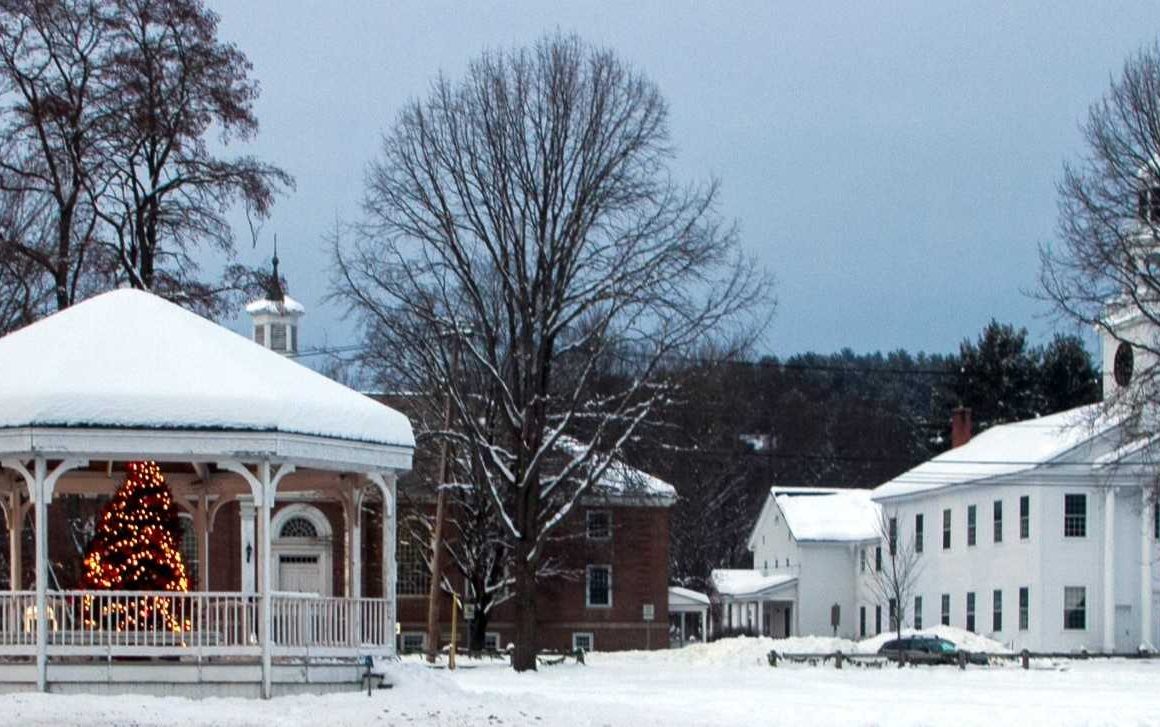
Each year, volunteers install the tree and decorate it in the gazebo in town and invite people to name those that they want to memorialize or honor. At one time, every Lions Club in Vermont hosted a Memory Tree, thanks to Wheeler’s encouragement.

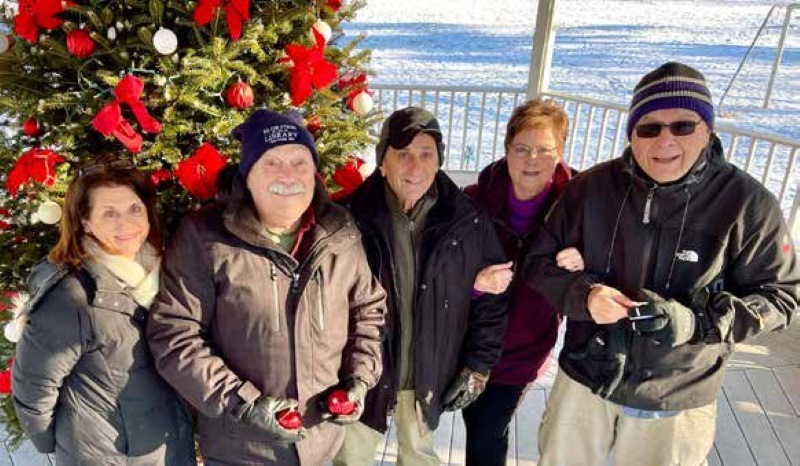
Left to right: Roseanne and Jim Maguire, Demosthenes (Demo) Sofronas, Fran and Gary DeGasta

The first year the Memory Tree program took place in Norwich, Wheeler memorialized his parents. His father was a general surgeon in Brattleboro and a 50-year member of his local Lions Club. “My mother was there to take care of us and support him because he was often called away on an emergency in town,” Wheeler remembers.

This commitment on the part of both his parents inspired Wheeler to take up a life of service. “I really enjoy helping others; the club is always looking for people who need help,” he says.

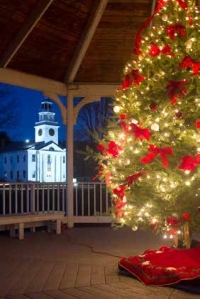
Lions Memory Tree

The Memory Tree program has evolved over the 44 years since Wheeler presented the idea to clubs around Vermont to include honoring a friend or family member who is still living as well as memorializing those who have passed on. The Memory Tree program is part of the 19 days of Norwich, and the Byrne Foundation matches the proceeds for a donation to the Upper Valley Haven – a non-profit organization that serves people struggling with poverty by providing food, shelter, education, service coordination, and other support.

The signature fund-raising event for the Norwich Lions Club is the well-loved Norwich Fair. Originally organized by local churches for the first 40 years, NLC took on sponsorship and operation of the fair in 1989 and has been providing fun and entertainment to all fairgoers ever since. The Club celebrated the 69th year of the Fair last summer, which has raised over $30,000 in recent years, far exceeding previous annual receipts of $18,000-22,000.

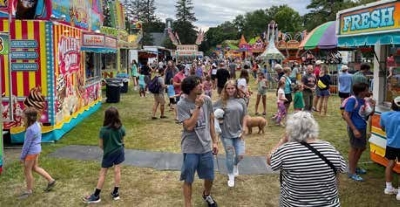
Norwich Fair midway 2023

Club President Fran DeGasta reflects on the many service-oriented benefits of the Norwich Fair: “Local non-profits partner with the club for their own fund-raising initiatives at the fair, and they can retain all of their proceeds. People really enjoy the popular dunk-tank attraction on the sidelines.” Until recently, the fair also featured a pig roast, King Arthur Pie Baking Contest, and bingo.

In addition, NLC solicits grant applications annually and has funded projects for nearly 40 different Upper Valley non-profits, schools, and community groups over the years. The list of funded projects is extensive – digital library materials, food resilience projects, heat pumps, medical equipment, and educational materials are just a few examples.

Early fundraisers included an annual Lions Minstrel Show, the sale of light bulbs, spring auctions, and sponsoring canoe races on the Connecticut River. Over the years, the Club has also held wine-tasting events at the Norwich Inn to support NLC’s service activities. In addition to the Norwich Fair and the Memory Tree, current major fundraisers include an annual “Meadow Muffin Contest” wherein participants purchase “plots”, hoping to be chosen for a prize by a bovine “plop” – a fan favorite of many native New Englanders. An online silent auction with over 200 items donated by local businesses and individuals throughout the Upper Valley raised more than $11,000 in 2022 to be offered in the Club’s granting program.

Many of the NLC’s community projects are part of an ongoing response to needs identified by members and may provide one-time or ongoing support. The various fundraisers support these initiatives as well. A partial list includes sponsoring free monthly dinner meals for over 100 adults and children at LISTEN, providing fuel assistance, cash donations and eye exams and glasses, delivering sand to seniors during the winter season, sponsoring bus transportation for children to local nursing homes to read to residents, and supporting the Pediatric Cancer Treatment Room Transformation Project at ChaD (Children’s Hospital at Dartmouth).

Similar to other service clubs, Lions Club members volunteer individually and collectively at various local and regional events for service, fellowship, and of course, fun. Collaborating with other Lions Clubs and local institutions, club members have planted trees, marched in parades, helped with elementary school reading programs, and provided voting outreach services. The reach of the Norwich Lions Club also extends to a Cabot, Vermont-based summer camp for children with vision and hearing loss. Lions provide lunches during registration days, host activities, provide equipment and games, and work with Lions from other clubs at the camp.

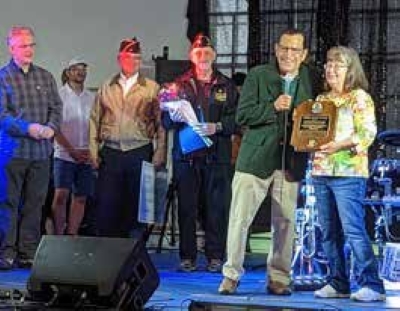
Past District Governor Phil Wheeler presents the Melvin Jones award to Bonnie Munday

The original founder of Lions Club International was Melvin Jones, a Chicago insurance salesman. In Norwich, as in many clubs, a fellowship has been established to honor the founder, and is presented to those who donate $1,000 to the Lions Club International Fund or to recognize a club member or citizen who demonstrates ‘above and beyond’ dedication to humanitarian causes. In 2023, the Club honored retired Norwich town clerk, Bonnie Munday, with the fellowship. Munday was instrumental in supporting the Memory Tree by annually posting a list of those who were memorialized and honored and managing donations.

Munday recalls her participation on a local Substack blog: “I tried to have a complete list up for the Christmas Pageant so that people could look at it and see that the memories they submitted were posted. I do hope the next clerk will keep up with this tradition.” Lion Stephen Flanders, a retired research civil engineer, and Nico Bekker, vice president of Ledyard National Bank, were awarded the fellowship in 2021. “It was an honor to get it,” says Flanders. “Nico and I each did things to help the club’s effectiveness with new fundraising procedures and by expanding our website.”

Lions International celebrated its 100th anniversary in 2017, and clubs around the world developed ‘Legacy Centennial’ projects to mark the occasion. In Norwich, the Lions Club purchased a basketball scoreboard for the Marion Cross Elementary School, installed tree signs on the Norwich Green, contributed a flag pole for the Norwich Police/Fire complex, and helped to fund the Norwich Veterans’ Honor Roll Monument.

As club members prepare to install this year’s Memory Tree for the 2023 holiday season, residents and visitors to Norwich can see it on display as they pass through town. “It’s a welcome sight as you drive into Norwich to see the tree lit up in the gazebo,” says Wheeler.

President Fran DeGasta hopes to see the next generation step in to get involved in community service with the Norwich Lions Club. ”Prospective members who are prepared to share the club’s commitment to helping others are encouraged to attend one of our meetings to see what we’re all about,” DeGasta says. “We come together as a club for the greater good of all.”

The Norwich Lions Club meets twice a month from September to June, on the first and third Tuesdays in the downstairs Community Room of the Norwich Public Library.

For more information on how to get involved in this active community service club, visit the club’s website at norwichlionsclub.org.

Share:
Reading time: 7 min
All, Cover Story

Two Decades of Dedication: Lucinda Walker, Norwich Public Library Director

June 14, 2022 by Cindy Heath No Comments

On a typical day at the Norwich Public Library, Lucinda Walker might find herself checking in with the library staff, responding to patrons’ questions about how their phones work, listening to a student talk about her day at school, loaning out an energy meter, managing the library budget, buying the latest books and media for the library collection, greeting enthusiastic library volunteers, and considering an innovative idea for a new library activity from a patron. And we used to think a library was only about books!

Celebrating 20 years as the Director of the library, what Lucinda has come to appreciate most are the positive relationships with the people who come to the library not only to check out books and media, do research, or play in the backyard, but to enjoy the sense of community Lucinda and her team have created for Norwich residents and guests.

Lucinda Walker

Lucinda credits the Norwich community for making the library the dynamic place that it is today, and is humble about her role in navigating the many changes in library services that have evolved over the two decades of her tenure. “I cannot believe it’s been 20 years. I feel so fortunate to be embraced by the community and the professionals and volunteers at the library. It’s so nice to go to work each day and be challenged and have an impact.”

Staying true to its mission to “…serve as a community center for the town providing traditional and innovative resources for all patrons and offering library experiences that support education, imagination, and community engagement,” Lucinda feels fortunate to have started working at the library when it had just been renovated. “With a brand new building, the community really embraced the library – it became the place to be after school. The community room was booked every night by local organizations, and still is. We went from a quiet library to a busy, vibrant community space.”

In fact, in 2020 the Library Journal designated the Norwich Public Library a ‘star library’, one of only three in Vermont, and 260 nationwide. The ranking is measured by circulation data, library and program visits, and public internet computer use. Lucinda notes, “We’ve been able to keep pace with trends, and the town has been amazing in its support.”

Stepping into the Director’s role in 2002, Lucinda followed Sylvia Fraser, the previous librarian, who oversaw the early library renovations. “Sylvia was a tremendous creator of collections. She applied for many grants that allowed for new shelves and additional staff for the library.” When Lucinda was hired, the Board supported her ideas for building on Sylvia’s efforts, and she was able to add a youth services assistant, fully staff the children’s area, and hire a programming person. “The additional staff meant we could expand children’s and adult programming. We also Increased the collection by buying DVDs, where we previously relied on donations, and expanded our audiobooks collection.”

Originally from Windsor, VT, Lucinda remembers talking with her high school guidance counselor about college. “He threw out the idea that I should become a librarian because I liked to read. I was incensed because the librarians I’d run into through most of my childhood were difficult people. They didn’t have much of a sense of humor, and didn’t really direct my reading.” Lucinda’s love of reading and research led to working in a library for a business newspaper in New York City. “This was the ’80s, before the internet, so you spent a lot of time at other libraries in Manhattan like the New York Public Library. I love untangling the puzzles I was given in that job.” Lucinda’s opinion of librarians took a 180 degree turn. “Librarians in college were amazing people.”

Lucinda earned a Master of Library Science at Long Island University and her library career was off and running with jobs at the Brooklyn Museum of Art Library and the San Francisco Mechanics’ Institute Library. “The Mechanics Institute Library was a technical institute created after the gold rush to keep people in the city – that’s when I got my real love of working with people.”

After moving back to Vermont, Lucinda explored many of the libraries throughout the Upper Valley. “At the time, it seemed like librarians were staying forever. In all honesty, I wondered if I was seasoned enough. When the Norwich position opened, I visited the library to get a sense of the place. I went in on Saturday, and saw Lisa Milchman, who was wearing Tevas with wool socks. I immediately felt like these were my people and that this was the spot for me. I was delighted and astonished that I was hired.”

The Norwich Public Library staff outstanding in their field

Many of the highlights of the past 20 years for Lucinda revolve around her interactions and relationships with people. “I’m wired to take risks in the library world, so when people come to me with a new idea, I like to help them achieve that idea. Being able to help shepherd people’s ideas forward makes the library a community-based institution.” Professionally, Lucinda has advanced her own creative ideas to improve communication and networking among librarians throughout Vermont. She co-founded the Green Mountain Library Consortium in 2007, which was successful in bringing the progressive notion of ebooks and audiobooks to Vermont. And, as of February 2020, the Norwich Library no longer charges fines for overdue items. “It’s something I’ve always wanted to do. Fines are a huge barrier to access, and eliminating them helps ensure that everyone can have equal access to the library.”

Lucinda’s leadership style is one of collaboration and listening. “I do my best work with a collaborative leadership model. Today’s libraries are community centers, and we take care of people at their best and sometimes their worst. We learn to become empathic by hearing other people’s stories and the library has to be a place where that can happen.”

During the 2008 financial crisis, Lucinda heard stories from fellow librarians in the Vermont Library Association about patrons sharing their stories of financial hardship. “I created a presentation about librarians as social workers, because people are often sharing very intimate parts of their lives with us.” This has been true as society begins to emerge from the pandemic. “Many consider this time ‘The Great Unraveling.’ We’ve all been isolated, scared, and grief stricken, and people are unburdening. We need to take care of each other during this time. We want every action we have with a person to leave them feeling better.”

Lucinda is excited to return to the time when libraries are the community places where you can pick up your dry cleaning, CSA share, and access the food shelves. “We’re happy to hold things for people to come and pick up. We rent electric bikes. We host Kindergarten Clean Ups for Earth Day. Community members host meetings here and can use the library as a work space and get tech help. Our WiFi is available 24/7.” Lucinda believes libraries are only successful if the staff and volunteers are able to connect with people and track down what they need. Much of the librarian’s day is spent troubleshooting and problem solving.

Along with curiosity, perceptively reading situations that arise, and extreme multitasking, communication and collaboration are all in a day’s work for Lucinda Walker. “Word of mouth continues to expand the use of the library. I want to shout out to the fact that a successful library is a wonderful reflection of the community it’s serving. Norwich is filled with remarkable people, and the Friends’ group is pivotal. We’re only successful because of our relationships with other people.”

Share:
Reading time: 6 min
All, Goodness InDeed

Solar Santa Flies Again

December 10, 2021 by Cindy Heath 1 Comment

When Norm Levy decides to learn about a new topic, he does his research. As a member of the Norwich Energy Committee and an emerging Upper Valley philanthropist, Norm is a passionate advocate for extending access to lower cost solar electricity for low/moderate income Vermonters and Upper Valley nonprofits. A retired laboratory physician who has invested wisely over the course of his career, Norm set about wanting to ‘have fun and do good’, landing on a non-traditional investment model called “community impact investing,” specifically focused on installing solar arrays. 

Says Norm, “I believe lower income Vermonters care as passionately about climate change as their more affluent neighbors, but feel they have to focus their finances on the basic needs of food, shelter, clothing, and childcare. I am fortunate that in retirement I have the means to help others, so I decided I was going to be the lone ranger in a wool cap and find a way to extend energy efficiency to low- and middle-income families in my own community of Norwich.”

What began as an LED bulb gifting program, distributing over 3,000 bulbs to Upper Valley families, has evolved into something much larger, and Norm has become conversant in the many aspects of solar power and its financing, including net metering, how solar arrays work, and tax credits for investors who support clean energy infrastructure. 

Norm’s chosen investment approach resulted in a novel partnership with Norwich Solar Technologies, which has completed two community solar arrays with Norm’s new company, Norm & Sun LLC. The first project was a standalone array that provided electricity for 25% less than commercial rates to 14 families living at Starlake Lane built by Twin Pines Housing. The project provides solar powered electricity to the non-profit COVER Home Repair in White River Junction as well. 

The second project is located on Turnpike Road, on land owned by Jay Mead and Edie Farwell and uses a different model – a larger “mixed” community array. Some solar panels are owned by 25 individual homeowners, while 110 panels are owned by Norm & Sun, LLC, providing electricity for the Good Neighbor Health Clinic in White River Junction. Edie says, “We were looking to see how we could further contribute to clean energy in Norwich. We’re so pleased that we could use an acre of land for a solar installation. It feels like a win-win-win all around. Norwich Solar Technologies has been an excellent partner to work with on this.”

Norm’s research has shown that socially responsible investing is more than a $17 trillion industry in the United States. “People want to put their money towards good works as well as investing in their future. Unfortunately, most of the investments go into large multinational corporations, and it is very difficult to direct investments into one’s local community. If more investors knew about these opportunities, it would give them a chance to make a positive difference in their own communities,” says Norm.

Community solar financed by private investors is a relatively new approach on the Vermont solar scene and more solar developers are beginning to adopt the model. Because the upfront costs of a solar project for an individual homeowner can be prohibitive even with government incentives, community impact investing allows homeowners and apartment dwellers to save money on electric bills and use clean solar power without the substantial capital outlay. 

Norm is an advocate of public-private partnerships to achieve his philanthropic aims. “Partnership with a private community investor is the key,” says Norm. Since the 1990s, tax laws have included incentives in the form of tax credits to encourage private investment in renewable energy, offsetting one’s federal income taxes. Low- and moderate-income residents pay lower taxes, and hence can access fewer credits. Norm explains, “So I figured that once I understood how this worked, I could ‘right size’ a solar project to an investment size I felt comfortable with, take advantage of the tax credits, and share the benefits with non-profits and lower income residents in the form of lower cost renewable energy.”

At the recent grand opening of the Turnpike Road project, Kevin Davis, VP of Sales for Norwich Solar Technologies shared some insights on why the Solar Santa model is a good one. “From an economic point of view, so much of the cost we pay for electricity goes to sources from out of the state, but community solar projects generate electricity locally. It keeps our dollars circulating in the local economy and creates renewable energy here in Vermont, making energy independence more feasible.”

Residential customers receive net metering credits to offset their utility bills, and Norm plans to transfer his credits to benefit the Good Neighbor Health Clinic. Landowners Jay Mead and Edie Farwell leased the land to Norwich Solar Technologies to construct the array. Says Jay, “We’re concerned about climate change, and we had this piece of land that had a good solar aspect. It does change the landscape, and I think it’s important that we see what the cost of our electrical consumption is.” 

For Norm, the big goal is to inspire additional public-private collaborations to extend renewable energy and utility cost savings to a larger number of communities and non-profits for decades to come. “If you are a beneficiary of the economy, you too can share your good fortune with non-profits and low-income homeowners.” 

Norm is the best kind of investor/philanthropist – a patient one. While the original return on his investment at Starlake Lane was projected at five years, he chose to provide a higher reduction in utility bills for the residents and COVER Home Repair, stretching his return to seven years, but he is fine with that – especially if it supports his mission to have fun and do good.

To learn more about how Norm supports clean energy for low- and middle-income families, email mnblevy@icloud.com. 

Share:
Reading time: 4 min
All, Cover Story

Local Dollars Staying Local

March 10, 2021 by Cindy Heath No Comments

Long before white settlers came to live in the Upper Valley in the mid-1700s, the Native American Chief Mascommah hunted and fished all along the Connecticut River Valley eventually settling in Northfield, Massachusetts. The name ‘Mascoma’ appears in many places throughout the Upper Valley, so it must have been a logical choice for the founders when Mascoma Bank was established 122 years ago in 1899 as a mutually-owned bank.

How has this Upper Valley institution maintained its community and local-first banking principals amidst so many technology, economic, and social changes over more than 100 years? According to current President and CEO (and former Norwich resident) Clay Adams, Mascoma Bank was intentionally designed to be locally owned and to support community philanthropy, and the bank has simply stayed true to its original mission. It is this community-first philosophy, along with solid strategic planning, that has helped Mascoma Bank weather many financial storms that have forced other banks to close or merge.

StoneLedge Stables and Finding Our Stride are two
Norwich-based nonprofits that have received funding
from local dollars circulated back into the
community through Mascoma Bank.

Adapting to new technologies has also helped the bank grow and change with the times. Clay notes, “One thing I’ve said consistently since I’ve arrived is that technology investments are absolutely critical,” says Clay. “We need to serve our customers’ needs where, when, and how they want to bank.” New financial products and tools constantly emerge under the banner of ‘fintechs,’ (financial technology companies) like mobile banking applications and simplified online banking services. “Community banks have not made the investments in technology that we should have, and traditional providers serving banks are not innovating as fast as the rest of the market.”

Clay became President and CEO of Mascoma Bank in January 2017, succeeding long-time President Steve Christy. After serving on the bank’s Board of Directors for five years and holding CEO roles at regional businesses like Simon Pearce and Resource Systems Group, Clay was ready to step into a new leadership challenge. “Growing up, I held a lot of leadership positions through high school and college. I naturally gravitated toward that aspect.”

Clay contributed to a number of organizations early in his career, and realized he was missing the top-level leadership experience. As his experiences evolved, Clay stitched together a ‘quilt of leadership models’ to inform his approach. “I’ve picked up different ideas about leadership by reading a lot of history and serving on boards with other leaders. All leaders have things they’re good at and not so good at.” Among the many skills required to be a successful CEO, Clay brought visioning, strategic partnering, and working with nonprofits, government, and business sectors to the Mascoma Bank Community. “I had great familiarity with the institution and the regions we serve, and we have a great group of employees I can rely on for the day-to-day operations.”

In keeping with its local-first philosophy, Clay helped the bank continue its journey toward becoming a Certified B Corporation, which is a legal commitment to consider the impact of decisions on employees, customers, the community, and the environment. Companies balance the ‘triple bottom line,” giving people, places, and the planet equal priority. “The Board had been discussing B Corp Certification for a couple of years, and we pushed it over the goal line. We felt we’d already been acting as a B Corporation since the bank was started by a group of citizens from Lebanon that pooled their money and didn’t expect a return. We grow our capital and give back to our communities. The B Corp mantra is ‘best for the world’ so making it official is a nice way to validate what we’ve been doing for 122 years.”

Indeed, significant funds have been contributed to Upper Valley organizations: $2 million in 2020, and more than $8 million over the past five years. In Norwich, Willing Hands, Upper Valley Trails Alliance, Norwich Library, The Family Place, and Montshire Museum have all received funding averaging $5,000 each for programs, equipment, capital campaigns, and events to support their operations and services.

“Keeping money local contributes to a virtuous cycle of job creation, philanthropy, community involvement, and local business ownership. Amazon is not going away and there are great benefits to that business, but it is also nice to have local institutions that are unique to and familiar with the Upper Valley.” The pandemic has inspired additional contributions by the Mascoma Bank Foundation to support childcare, racial equity, affordable housing, and nonprofit organizations that rely on visitors. “Philanthropy drives a lot of the behaviors at the bank, not just in terms of the money we want to give away, but in how we conduct all of our business; it’s a lot easier to work harder and longer when you’re doing it for a higher purpose.”

Clay Adams

With 28 branches stretching across northern New England, Mascoma Bank’s community betterment impact is significant. It also reaches far beyond the Upper Valley because of a unique award from the US Treasury in 2020. In recent years, the $170 million New Markets Tax Credits (NMTC) allocation from the US Treasury has allowed the bank to help stimulate business development in underserved urban and rural neighborhoods. The bank has awarded NMTC Funds to develop the Nashua Performing Arts Center, a hotel in Burlington, a steel fabrication operation in Berlin, NH, and several other projects which are still operating despite the pandemic.

Benefitting Local In 2020, Mascoma Bank donated a total of $36,150 to these Norwich-based nonprofits:
  • Finding Our Stride
  • Montshire Museum of Science
  • Norwich PTA
  • Norwich Public Library
  • StoneLedge Stables
  • Student Rescue Project
  • The Family Place
  • Upper Valley Community Grange
  • Upper Valley Trails Alliance

For Clay Adams and the more than 370 Mascoma Bank employees, community service is both a personal and professional ethic. Currently, Clay serves as a member of the Board of Directors of the Montshire Museum of Science, Alice Peck Day Hospital, Ford Sayre Memorial Ski Council, and Vital Communities Corporate Council. Each year, Mascoma Bank employees provide hands-on help from building projects to mentoring students and helping seniors through the Bank’s paid Volunteer Time Off program.

For 122 years, it’s been a win-win situation for both the bank and the communities that it serves, says Clay. “As the bank grows and is more profitable, we return more money to the community. This is one of the most meaningful parts of being with a bank dedicated to making a difference.”

Clean Yield Team’s Annual Retreat
Share:
Reading time: 5 min

Our Latest Issue

Fall 2026 Edition

© 2024 copyright Greater Good Media. All rights reserved.