Home
About Norwich
Our Team
Content
    All Articles
    Cover Story
    Animals Rule!
    Around Town
    Artist Profile
    Creating Community
    Elder Profile
    Green Page
    Goodness InDeed
    History
    Life at 531 Feet
    Meet your Neighbor
    School Days
    Your Green Spaces
Our Sponsors
Advertise
Archives
Contact Us

Norwich Times - Good People, Good Places, Good Things Happening
  • Home
  • About Norwich
  • Our Team
  • Content
    • All Articles
    • Cover Story
    • Animals Rule!
    • Around Town
    • Artist Profile
    • Creating Community
    • Elder Profile
    • Green Page
    • Goodness InDeed
    • History
    • Life at 531 Feet
    • Meet your Neighbor
    • School Days
    • Your Green Spaces
  • Our Sponsors
  • Advertise
  • Archives
  • Contact Us
All, Norwich Historical Society

Treks Through Forgotten Norwich

September 16, 2026 by David Callaway No Comments

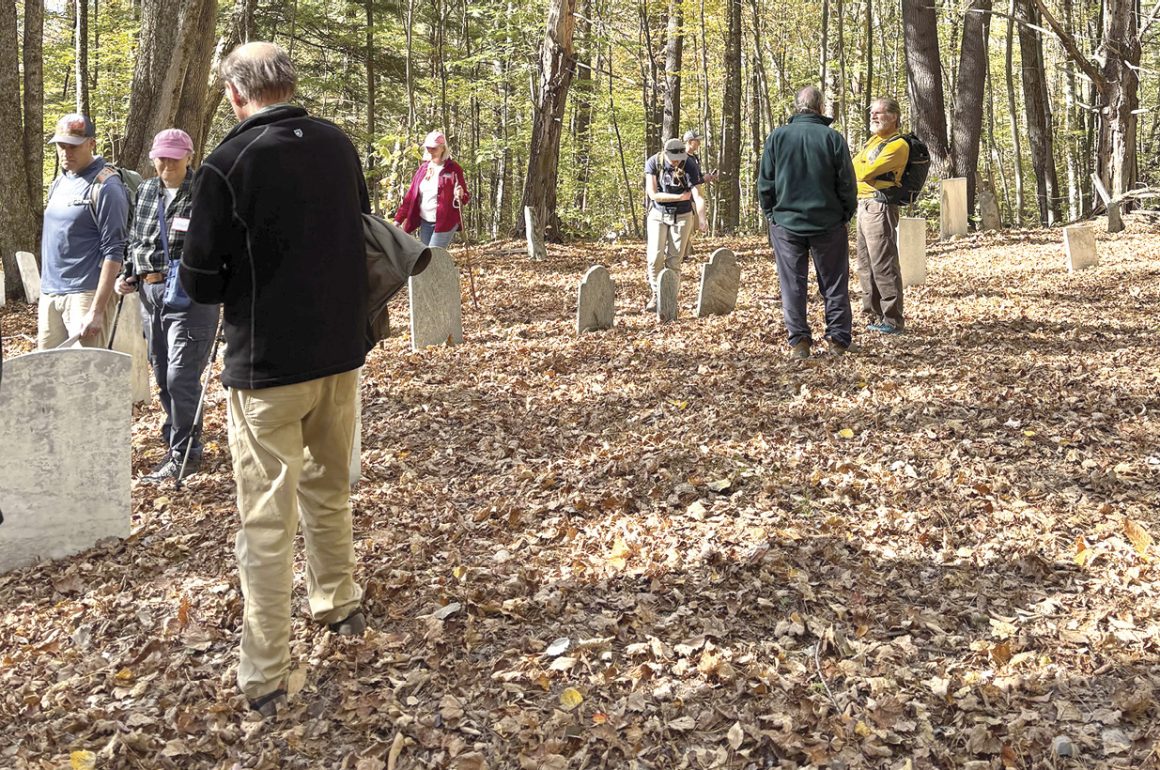
Have you ever wondered about the stone walls that line the fields of Norwich or cellar holes deep in the woods, or a small cemetery just off a hiking trail? Who lived there and when? Why did they leave? Many of these historical questions will be discussed during two fall foliage hikes sponsored by the Norwich Historical Society. One will explore Parcel 5 and the other will unlock the history of a settlement on Griggs Mountain.
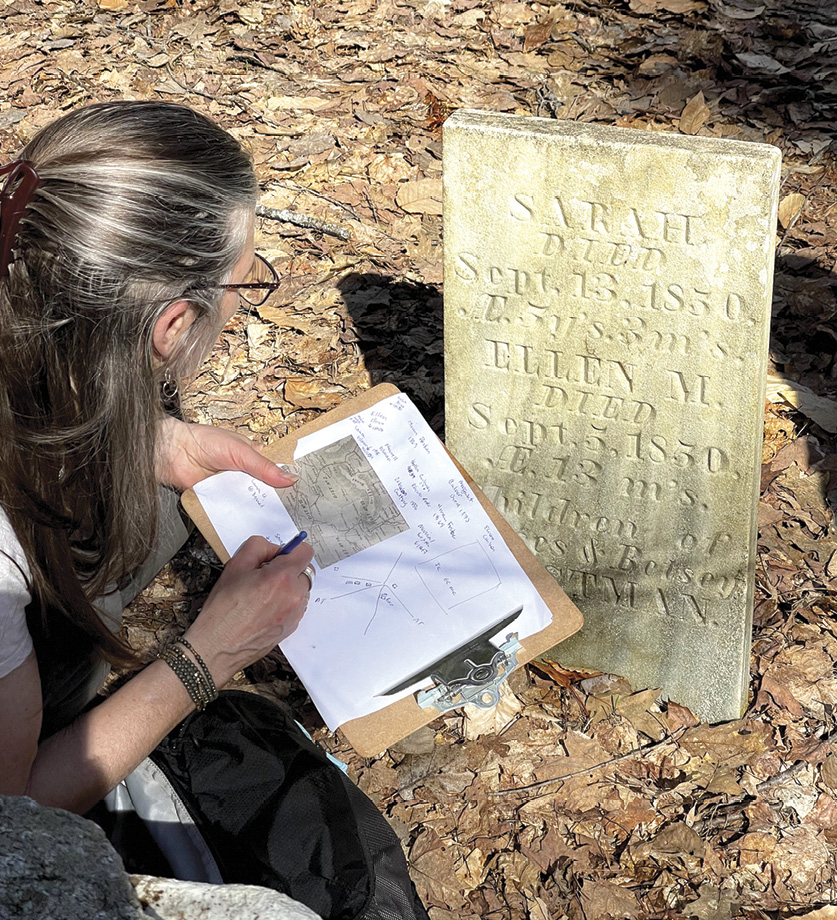
Cheri Mather gathering information to prepare for the tour.

Griggs Mountain

Situated high above Norwich on Griggs Mountain, off the Appalachian Trail, a small community of farmers settled in this area at the beginning of the 19th century. What remains of those families today are farm foundations, remote trails through the woods that used to be roads, and the abandoned Parkhurst cemetery. Parkhurst is the hardest-to-reach cemetery in Norwich and the final resting place for eight different families. Tragically, 12 out of the 21 of the people buried here were younger than 25. The last burial was in 1873.

It seems odd today that Norwich farms in the early 1800s were built on high hills. Venturing to the village was a four-hour trek by an oxen-pulled wagon over dirt trails. But living in the hills in those days made the settlers less vulnerable to flooding and the trees higher up were thinner and easier to clear.

The settlers cleared the land, planted wheat, rye, “Irish” potatoes, “Indian” corn, and hay. They also raised sheep, pigs, cows, and bees, and sugared. And to top it off, cords of wood needed to be cut, stacked, and dried to provide heat for the long Vermont winters.

Through research of town and local cemetery records and the study of population and agricultural censuses, the NHS has pieced together some remarkable tales of those early, hardworking settlers and their descendants during the 100 years the community was active. Join the NHS tour this fall to hear these stories, walk among the gravestones and explore the old foundations to learn more of the history of this vanished community in the woods. The two-mile Griggs Mountain hike begins off Bragg Hill and covers some uneven terrain, so wear sturdy shoes and bring your imagination to fully enjoy it.
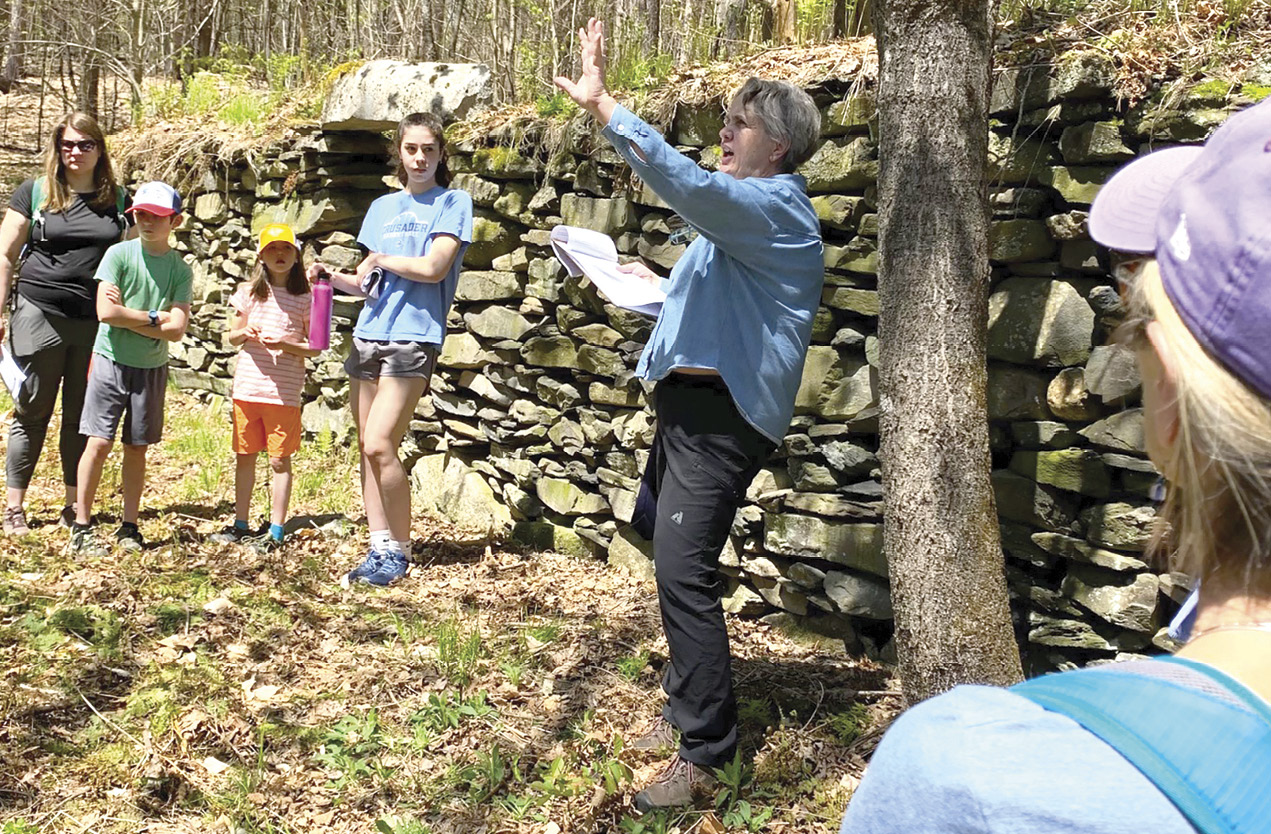
NHS Director points out cellar hole features of the Brown Barn foundation at Parcel 5.

Parcel 5

For a fall foliage hike close to town, consider a trek through Parcel 5, a historic hiking area a couple of miles out of town on Beaver Meadow Road.

Israel and John Brown settled on the land in the 1790s and had adjoining farms and several plots of land across the road and along the Charles Brown Brook. Their descendants owned the land until 1926, when it was sold to the Norwich Water District to ensure safe drinking water for the Charles Brown Brook watershed, which was sent to town in wooden pipes.

Parcel 5 has an ancient history that impacted how the Browns developed their land. 15,000 years ago, the area was covered by a mile-thick sheet of ice. The ice slowly melted and was gone 13,000 years ago, but a large dam formed near Middletown, Conn., and water backed up all the way to St. Johnsbury, creating what is now known as Lake Hitchcock. Once the water retreated, rocks dropped by glaciers were slowly buried. Soil covered them. Trees grew over them.

The Browns cleared the fields of trees and plowed them, kicking up rocks that were hauled from the fields and used for stone walls and foundations. In the 1840s, there were over 13,000 sheep grazing the hills of Norwich; by 1850, nearly every farmer in Norwich kept an average of 55 sheep. The combination of deforestation and sheep grazing dislocated even more stones. Supplies of wood shrank; supplies of stones rose.

The abundance of stones was put to good use by the inventive Browns. The guide on the Parcel 5 tour will explain how to look at stone walls and point out how they were used for fencing, separating fields, and foundations. Hikers will see plans for the Brown farmhouse and its foundations, and examine what remains of them. This tour will take you from the Ice Age to a 19th-century Norwich farm. Learn the history of the farm through diaries and census records and be astounded that the Browns had an apple orchard that grew 2,000 bushels of apples a year and turned it into cider at a mill in Beaver Meadow.

Along with the Griggs Mountain hike and the trek through Parcel 5, an interested hiker/historian might also like to explore the Ballard Trail or climb up the switchback path to Gile Mountain. The Norwich Historical Society has more hiking options and trail histories at norwichtrails.org/trail-histories, and check out norwichhistory.org for the fall foliage hike schedule.

Share:
Reading time: 4 min
All, Norwich Historical Society

Close to 200 Years of Shopping A Timeline

June 21, 2026 by Sarah Rooker No Comments

There has been a store at the Dan & Whit’s location since 1829.

Message in a Bottle
While researching the history of the property where Dan and Whit’s currently resides, we found a newspaper article relating a story from the day after the 1889 fire when the building burned. According to town legend, when the corner stone of the hall was laid, a bottle containing some kind of fermented liquor, together with a paper on which was recorded the date of the event, had been enclosed in the brick and mortar.
On the morning after the fire, a group searched the ruins of the foundation for the hidden bottle and found it. Inside was a note: “This bottle contains New England rum, and was deposited here on the 24th day of June, 1829, by John Wright who built this building.”
––°––
1829
John Wright first developed the block in 1829, which was known as Franklin Hall. The Norwich Bookstore, located at the south end of Franklin Hall, was also an apothecary. Downer and Burton operated a general store in the north end of the building.
Upstairs, Franklin Hall hosted dinners, cotillions, and other social events, many of which were associated with the American Literary, Scientific, and Military Academy.
The store building is on the far left in the photograph. In the 1860s there were at least three businesses in the store building on the first floor.
––°––

1929

1865
On the day the news arrived in Norwich that Lincoln had been assassinated, “old men in the village stood in front of the store unashamedly weeping.”
The store was a central space for the entire community. It was a gathering space for news —especially in times of hardship.
––°––
1889
In 1889 Union Block, as it was called, was destroyed by fire. There E.W. Olds had been operating a post office, dry goods store, and grocery. “Everything in the building was lost, post office and the entire contents of a heavily stocked country store, excepting the ledger which was in the safe and was preserved.” Farmers who were about their chores saw the fire or heard the bells and came running to help. The college bell was rung and the Hanover Engine came. Several wells were run dry as they worked to save the hotel and neighboring house.
––°––
1891
The Newton Inn and general store building were re-built soon after the fire.
––°––
1914
Arthur Henry Merrill and his wife, Ada, purchased the store in 1914. Leon and Florence Merrill became the owners in 1948.
––°––

1914

1932
In an interview with Whit Hicks, he shared: “I went to work at Merrill’s General Store in 1932 and Dan Fraser came a year later. We used to run a delivery cart. That is, we used to go up to different houses in the morning, and take orders. We’d sit in the kitchen and talk to the lady of the house and we’d tell her what specials might be on … After taking orders all morning, we’d go to the store and put the orders up and then deliver them that same afternoon.”
––°––
1955
Leon Merrill sells the business to Dan Fraser (employee since 1933) and Whitney “Whit” Hicks (employee since 1932). Wood heat replaces the coal and oil furnaces.
––°––

Fraser and Hicks

1957
Fraser and Hicks buy the property. The store name changes to Dan & Whit’s after Fraser and Hicks decide to stay open until 10:00 and sell beer, wine, and guns. Merrill was opposed to these practices and insisted they change the name.
Bunny Fraser would roll a shopping cart down the road to the bank to make the nightly deposit because the coins were so heavy.
––°––

1963 and 1968
The store expands with a checkout area, meat and hardware departments, and loading dock. The house next door was razed to expand the parking lot.
“I have read that your average hardware store has a total of 25,000-35,000 items. That’s of course counting every screw and bolt and washers and nail sizes. I don’t know just exactly what we have, but my guess is that we have something over quarter of a million.” ~ Jack Fraser
––°––

1972

1972
Whit retires and Dan Fraser buys Hicks’ interest in the business. Frasers’ General Store, Inc. was formed. Sons George and Jack Fraser end their careers in the U.S. Army and enter the family business. A third addition to the back was built.
––°––
1973
Vermont’s bottle deposit law causes Dan & Whit’s beer sales to drop 55% as sales shift to New Hampshire.
“This is a family business. It means a lot to us to keep it running, but, you can’t keep it running if you can’t keep viable. If you pay too much out in taxes and that kind of thing, all of a sudden you can’t compete in wages for your people and you can’t compete on price. It’s a challenge.
We try to be very careful to treat people well, to help people, to make sure when they leave, they have a feeling that they came here for help and they got the help and not some smart answers or brush off. Because, that’s probably our means of survival.” ~ Jack Fraser
––°––
1996
Jack and George Fraser are honored by the Vermont Grocers Association as Retailers of the Year.
––°––
2013
Dan Fraser begins 19 Days of Norwich to benefit the Upper Valley Haven.
––°––
2020
Dan & Whit’s is a community leader during COVID-19.

Share:
Reading time: 4 min
All, Norwich Historical Society

The Emerson Brothers

June 10, 2018 by David Callaway No Comments

In 1824, Edwin Ferry Johnson, a young cadet at Alden Partridge’s military school, hiked up Norwich’s Prospect Hill, plunked himself down and drew a detailed pen and ink sketch of Norwich with Hanover in the distance. The drawing includes the South Meeting House, which later became the Congregational Church, and Alden Partridge’s American, Literary, Scientific & Military Academy, which became Norwich University in 1834. Johnson’s sketch shows a prosperous village that had seen its population grow from 1,158 in 1790 to 2,316 in 1830. Wool production, apple growing and farming were fueling the growth. A toll bridge to Hanover was built in 1796. A year later, Jasper Murdock built his elegant home that was both a stagecoach stop and tavern near the corner of what is now Beaver Meadow Road and Main Street. A post office opened in 1805.  The village was thriving; into this development stepped the Emerson family from Westfield, Massachusetts.

From the day they first arrived, Elihu, Joseph and Thomas Emerson and their cousin, John, worked in the community as merchants, speculators, smithies, farmers, builders and town officials. Acting singly or together, the Emersons invested in many properties, including a 100-acre lot of two thousand apple trees.

Norwich 1824

Elihu Emerson, the oldest of the Emerson men, headed from his family home in Westfield, Massachusetts to seek his fortune in Norwich in 1792, soon after he turned 21. Westfield is not far from the Connecticut River, so it’s possible Elihu paddled upstream to Norwich. But, alas there is no record of how he first journeyed to his new home. Shortly after he arrived, Elihu, who was a blacksmith by trade, set up a shop. In 1794, he built just south of his blacksmith shop what many believe was the earliest brick house in Norwich. The house at 332 Main Street still stands today, opposite Beaver Meadow Road. In 1798, Elihu and Thankful Grant were married and raised six children together. The large family may have prompted him to build a larger home next to his first home which is known today as the “The 1820 House.” The exterior of the house looks much as it did when it was first constructed, only a projecting porch now covers the front door.  “The interior is noteworthy,” explained The Early Houses of Norwich, Vermont  “for the beautiful treatment of one of the main rooms on the second floor… there is a paneled fireplace and on either side of it recessed alcoves with seats, the alcoves being spanned by graceful arches.”

Mr. Emerson was a sturdy New Englander.  He outlived his first wife and then also his second wife who died when she was eighty.  According to one story, Elihu, who was considered quite agile his whole life, placed his hands on his horse’s back and mounted “thereon from the ground on his seventy-first anniversary of his birth.”  Elihu died at his daughter’s home in Leicester, Mass in 1873 at the “advanced age of over one hundred and two.”  His remains were returned to Norwich and placed in the Fairview cemetery near his brother Joseph’s grave.

Joseph Emerson followed Elihu to Norwich and, in 1796, purchased land on “the highway leading from Dr. Joseph Lewis’s house to the Meeting House.”  Around 1815, Joseph built a house on his land “at a time when he was in his middle forties and just beginning his active career as a builder in Norwich.”  The “1815 Emerson House” still stands on the east side of Main Street. The building to the north, which now houses the Ledyard Bank, was once his workshop where he made a living as a builder and a hat maker.  According to The Early Houses of Norwich, Vermont the house was “almost a twin to Elihu’s house…and the decorative treatment is unusually rich, and would lead us to suppose that Joseph was fond of all kinds of carved detail, panelling, etc.”

Joseph was “engaged considerably as a builder”—and considerably is the word.  Following the construction of his own home he built “The Partridge House” on Main Street. Now a B&B, the house is an impressive brick structure. Next time you walk by, take a look at the doorway and the triple window above the door which is “…itself treated like a doorway with sidelights and elliptical fanlight.” Joseph also built the third brick house on the left as you enter Norwich and probably had a hand in the building of his brothers’ homes.

Elihu Emerson at 91. He lived to 102

One of the striking features about the brick houses built in Norwich between 1810 and 1830 was the beautiful color of the brick described as “a warm soft red, almost a salmon-pink.” These bricks were made in a brickyard located on Blood Brook near the intersection of Main Street and Route 5. In all probability, the Norwich brickyard was the earliest brickyard in this region.

Thomas, the last Emerson brother, arrived in Norwich in the early 1800s. Thomas “was bred a merchant” and “parlayed an inheritance from his great-grandfather Pratt, a Boston banker, into a fortune.” In 1807, Thomas moved to Detroit, Michigan where he formed a partnership with Stephen Mack. The firm Emerson, Mack & Conant, “kept a general assortment of dry goods, groceries and hardware.” They traded with Native Americans and the American military and had a very lucrative business until Detroit was surrendered to the British in 1812. With this “interruption of business, Mr. Emerson withdrew from the firm and retired to Vermont where, with ample means, he entered upon a more public and notable career.”

When Thomas returned to Norwich to join his brothers, the Emerson community spirit kicked into high gear. In 1817, Thomas and his brothers pledged almost 50% of the funds needed to erect the South Meeting House which later became the Congregational Church. Joseph became the builder of the Meeting House. Half of Thomas’s $600 pledge paid for a Revere Bell that he had carted to Norwich by oxen from Massachusetts. Although it is not mentioned in any history, a simple yet elegant weather vane atop the South Meeting House was almost certainly crafted by Elihu Emerson, the first known blacksmith in town. That same year, the Emersons backed Alden Partridge’s desire to build a military academy on the Plain. Today this is the village green. In 1819, Joseph Emerson was awarded the contract to build the Academy. He finished the South Barracks in 1820 and completed the North Barracks in 1832. In 1820 Thomas became involved in politics and represented the town between 1824-1829 as a Jackson Democrat. “Mr. Emerson was a good representative, in his day and on a small scale… was a good example of a political ‘boss.’”

In 1820, Thomas Emerson bought a lot from Cyrus Partridge and built his own house diagonally across from “his” meetinghouse in 1822. Today, the house holds the post office and is known as the Emerson House. Not to be outdone in the 1820s, John Emerson, Thomas’ cousin, built a large house on Main Street, just beyond the Main Street-Beaver Meadow intersection and opposite the Grange Hall. “Originally this house was entirely heated, of course, by fireplaces, but in 1889 or 1890 the first furnace and the first bathroom in Norwich were installed.”

The Emersons left their mark on Norwich in more ways than one.

Today, if you have the time to stroll down Main Street you can still see many of the structures that Edwin Johnson sketched in 1824. If you look closely at the drawing, you can pick out Elihu Emerson’s blacksmith shop and the home he built in 1820. And, further still, you can spot Joseph’s home on Main Street and Thomas’s home which is on a diagonal from the South Meeting House. With a savvy eye for style and sturdy building, the Emersons set the standard in Norwich for home construction. Their legacies are with us today, two centuries after they were constructed.

Many thanks to Nancy Osgood for her detailed research on the Emerson family. To learn more about the early homes of Norwich be sure to attend the House and Garden Tour, “The Art of the Past: A Stroll Down Norwich’s Historic Main Street” on June 23rd.
Share:
Reading time: 6 min

Our Latest Issue

Fall 2026 Edition

© 2024 copyright Greater Good Media. All rights reserved.