Home
About Norwich
Our Team
Content
    All Articles
    Cover Story
    Animals Rule!
    Around Town
    Artist Profile
    Creating Community
    Elder Profile
    Green Page
    Goodness InDeed
    History
    Life at 531 Feet
    Meet your Neighbor
    School Days
    Your Green Spaces
Our Sponsors
Advertise
Archives
Contact Us

Norwich Times - Good People, Good Places, Good Things Happening
  • Home
  • About Norwich
  • Our Team
  • Content
    • All Articles
    • Cover Story
    • Animals Rule!
    • Around Town
    • Artist Profile
    • Creating Community
    • Elder Profile
    • Green Page
    • Goodness InDeed
    • History
    • Life at 531 Feet
    • Meet your Neighbor
    • School Days
    • Your Green Spaces
  • Our Sponsors
  • Advertise
  • Archives
  • Contact Us
All, Cover Story

Gather ’Round for Some Perspectives on Life and Learning

July 4, 2025 by Rose Terami No Comments

What often goes unnoticed about a good book is that the book’s origin story is often as interesting as the story within the book itself. Understanding the author’s own life journey adds perspective and inspiration to the reader’s experience.

That’s why, if you attended Norwich-based author Ken Cadow’s talk at the Norwich Public Library earlier in April, you might have a new window into his recent novel, Gather – a coming-of-age story set in present day Vermont, that explores themes of youth, education, family, struggles with addiction, and resilience – told through the eyes of a teenager named Ian.

Ken Cadow grew up in Rhode Island and spent his summers on Block Island. He later graduated from Rhode Island College with a focus on computer science and English and ended up jumping around in professions and interests.

“I would describe myself as an avid lifelong learner, always wanting to know more, but I really don’t care about formal credentials,” he says. Realizing this, Cadow opted to drive a taxi cab after graduating college instead of putting his degrees to ‘logical’ use. He joined the Navy where he was an officer for four years, then opened up a grocery store and wholesale business in Rhode Island, then he met his wife and started a family before landing in Norwich in 1997, where they have lived ever since. This is where the writing comes in.

For Cadow, writing and publishing Gather was a process spanning years, full of starts and stops, re-routing and re-writing, and lots and lots of thinking. In 1999, Cadow was inspired by an encounter he had while interviewing local hunters for an oral history project through the MALS (Master of Arts in Liberal Studies) program at Dartmouth College. “I was really struck by how, typically, you put a bunch of teenagers with a bunch of people who are older than they are, and they don’t say much, but I found that in the hunting camps, they were really leaning into the whole experience and part of the conversations.” A big parcel of nearby land had just been posted, and the hunters were sharing their disdain for this newfound situation. “They were talking about how it was harder and harder to find places to hunt,” Cadow says. “I thought, it would be really interesting if one of the kids in this hunting camp fell in love with the daughter of the family who just bought this land and moved into town…that would be an interesting dynamic to explore in a book.”

Where Ken has spent countless hours contemplating,curating, developing, writing.

Where Ken has spent countless hours contemplating,
curating, developing, writing.

Cadow had been jotting down notes to develop a plot, “But I could never find the character that I wanted to stick with to tell that story,” he says. Twenty years later, “Ian walked onto the page.”

With another two decades of Vermont living under his belt and having worked with local kids in various educational roles, Cadow felt better equipped to bring this story to life. From the winter of 2019 when Cadow picked his pencil back up, it took him about eight months to finish the first draft. “After a while, I stopped paying attention to who the audience was and paid a lot more attention to who the narrator was,” he says. “My whole focus really became owing it to the character to get the story out.”

Inspired by some of Cadow’s real-life observations and experiences, but completely fictional, Gather takes a thoughtful approach to define learning, battling the notion that a “one size fits all” education isn’t the answer, or even close to it. In Cadow’s experience, he learned how to do things in school, but later learned how to use those things outside of school. “For me, that’s the ideal learning environment – through application,” he says. “The most important thing for me was always not necessarily utility, but the satisfaction of putting knowledge to work…[Things] have come a really long way since I was in school in terms of how we reach kids and have more opportunities than just desk learning,” he adds. “But I think we still have a long way to go.”

Gather’s main character, Ian, exemplifies an all-too-common struggle between student and the “system” – an educational model that’s outdated, inefficient, and “top down”, as Cadow describes. “The creativity is happening at the ground floor,” he explains, with passionate teachers who want to meet students where they are. “I wish we didn’t make such a huge distinction between learning by doing and desk learning that we do in our system,” Cadow says. “Everybody needs the exposure [to both types] to figure out what they might want to do next; figure out where their strengths are.”

“One of the things that drives education to be so expensive is that we’re trying to make something that’s busted work for too many people,” Cadow adds. “Instead of simplifying the system, we’re trying to simplify how we pay for it.”

As a former educator at various schools in Vermont and as the current administrator at Oxbow High School in Bradford, VT, Cadow witnesses the educational lives of his students daily, celebrating their wins and coping with their struggles alongside them. The shift in recent years has prioritized testing – especially since Covid-19, which focused more on learning lost than the potential for learning gained, Cadow says. Instead, Cadow raises the questions: “Why have kids stopped associating what they do at home with learning?” and “How can students see themselves as learners 24/7?”

With that in mind, Gather is more than a book – it’s a testament to the very real experiences of learners and educators everywhere – rural and urban, young and old, those concerned with tradition and those who desire to stray from the norm. Ian’s story represents that of “good kids who struggle with a system that’s not as flexible as we need it to be,” when “the systems that are intended to support him don’t.”

“I would love to challenge every person who’s looking at public education to ask themselves a couple of things,” Cadow says. “One is, ‘if it’s all this race to the top, what are we doing with everybody else and why do we have to define it that way?’” And, “Another thing that I wish we paid more attention to is – when the supply chain got really tight – how much we need our people who are capable of producing that which literally sustains us…I think Norwich is pretty great about that, but it’s a little bit of a bubble economy. How do we make it less of a bubble?”

Now, Cadow has been spending time on another book that’s been in the works since 2002 (he points out that with a full-time job as a principal, he only has time to work on his book over school vacations and for a few hours at a time on the weekends). He’s always keeping notes on a potential sequel to Gather, but for now, it’s one book against the world – a world that could use some added perspective.

Share:
Reading time: 6 min
All, Cover Story

“Being Merry in the Sunshine” Marion Cross School Celebrates Mayfest 2025

by Devin Gifford No Comments

Every year, on a Thursday in May, students of all ages at Marion Cross School gather on the Norwich Green to sing, dance, and welcome the sunshine. Community members join them on picnic blankets to enjoy live music performed by the school band and watch the students’ performances. Mayfest is a long-standing tradition at Marion Cross—a spring festival that has been celebrated for as long as many faculty members can remember.

Students look forward to performing all year long. In the weeks leading up to the festival, they spend lots of time outside practicing and perfecting the songs and dances specific to their grade level. They also create colorful garlands to wear and vibrant paper decorations to adorn the Green.

This is Travis Ramsey’s eleventh year teaching music to children from Pre-K through sixth grade at Marion Cross. He leads both the chorus and the band, and has been working hard to prepare students for Mayfest. “It’s a chance for the kids to come out and celebrate spring with singing and dancing,” Ramsey says.

The songs and choreography students learn for the festival vary based on their age and skill level. Much of the performance is rooted in tradition, with each grade typically participating in the same dances each year—drawing on New England’s rich history of folk music and dance. Contra dancing, for example, is a centuries-old folk tradition that remains popular in New England today. Accompanied by fiddle and accordion music, this communal dance involves long lines of dancers pairing up and moving in rhythmic patterns. It’s meant to be a shared experience, and Mayfest proudly upholds this spirit of togetherness as students sing and dance side by side.

Mia Tesone and Lucy Gaugh

Mia Tesone and Lucy Gaugh

The sixth graders, the oldest students at Marion Cross, cap off the festival with a series of maypole dances. A maypole dance is a traditional folk routine in which dancers move around a festively decorated pole, each holding a ribbon attached to the top. As they circle the pole, they weave intricate patterns with their ribbons. At the end of the dance, the ribbons are swiftly unwound in a dazzling swirl of color and movement. It’s a beautiful and symbolic way to welcome spring. Younger grades perform dances appropriate to their level, building up to the maypole dance in their final year at Marion Cross.

“The kids really look forward to being the biggest kids in the school and getting to perform this intricate maypole dance,” Ramsey explains. “It’s like a rite of passage.”

Georgia Gollub and Jaden Stocking

Georgia Gollub and Jaden Stocking

The long-standing tradition of Mayfest spans generations at Marion Cross School. Some current faculty members, who attended MCS as children, recall Mayfest with deep affection. Ross McGee, now a math coach at the school, is one such alum. He remembers feeling jealous of his older brother, who performed the maypole dance three years before he got his chance. “I eagerly awaited my turn to be a ‘big kid.’ The songs, the dancing, and being outside as an entire school community are memories I will always carry with me,” McGee says. The maypole dance gives students a joyful milestone to look forward to and fondly remember.

Hillary Roberts, a self-proclaimed “Marion Cross School Superfan,” was a classmate of McGee’s and now works as an education assistant at the school. She describes Mayfest as a tradition that makes Marion Cross “truly magical.” Like McGee, she recalls the 5th and 6th grade dances as highlights of her experience. “It was such an honor to finally be a fifth grader and wear all white with bells around our ankles while we did the ‘stick dance,’” Roberts shares. The stick dance, a beloved tradition for fifth graders at MCS, features students dancing and playfully jousting with poles.

The memories of Mayfest stay with Marion Cross students for decades. Ania Safford, a member of the class of 2000 and now a sixth-grade teacher at MCS, paints a vivid picture of her own Mayfest experience: “I can easily transport myself back to the meadow on a beautiful spring afternoon—the field filled with colorful flying flags, the sounds of accordion, fiddle, and guitar music, Maypole ribbons floating in the wind, and picnic blankets covering the hillside.” That tranquil joy is what alumni remember most dearly.

Mayfest offers students at Marion Cross a chance to learn traditional folk dances and perform them for their community on the spring Green, creating memories that last a lifetime. “The students get to put their teamwork and musical learning into action,” says Ramsey. “It’s an important way for us to contribute to our community.”

Share:
Reading time: 3 min
All, Cover Story

Skating in Norwich: A Community Effort, Then and Now

February 22, 2025 by Devin Gifford 1 Comment
The hosing team that helps keep the Norwich rink smooth and ready for skating all season long.

The ice rink in the center of the Norwich Green is up and running for another season of winter fun. The creation and upkeep of the rink has been a tradition of the community since at least the ’70s, though skating on the green has likely been a common winter activity for much longer. What started out as a single volunteer standing out on the green with a hose has transformed into a community effort that takes dozens of volunteers each season. Thanks to the tireless efforts of these volunteers, Norwich residents get to enjoy gathering at the rink to skate and socialize during these cold winter months. They call it a “special spot.”

“I used to plow it with my truck and was sometimes helped by one of Leonard Cook’s men,” says Norwich resident Milton Frye, who helped with the rink back when it started in the ’70s. “Volunteers helped me at night to flood the rink with fire hoses that we stored in the basement of the 1898 building.”

THEN: Skating on the town green in Norwich, circa 1940s. Photo by Collamer Abbott NOW: Skating Party in Norwich.

THEN: Skating on the town green in Norwich, circa 1940s. Photo by Collamer Abbott NOW: Skating Party in Norwich.

In the early years of the rink, there were no boards around its edges, “but there was always enough snow so that snow banks held the water,” Frye adds. “It seems like there was always a lot of snow. For a while the shape of the rink was an ‘L’ so that both hockey and free skating could take place at the same time.” Members of the community offered their help and talents (as they still do today): “At some time in the ’90s, Jeff Marshal took over the responsibilities of maintaining the rink. He even brought his own snow blower down to school,” Frye remembers. “Peter Anderson welded hockey nets,” and “Ceci Tseng, a teacher, had skates for everyone in kindergarten so that they had an early start on the ice. There were always skates for children to use.”

Norwich residents gather around the fi re pit at the annual
skating party.

“There were never any restrictions about skating because of temperature,” Frye adds. “-10° was never too cold.”

Brie Swenson, recreation director in Norwich, has been working with volunteers to support the creation of the rink over the past few years. Each year, Swenson coordinates with the “head hoser,” an affectionate nickname for the volunteer that leads the project, to get the rink operational before the holiday break, weather permitting. Swenson worked with this year’s head hoser, Buck Child, as well as a team of local volunteers, the Department of Public Works, and the Norwich Fire Department to get the rink set up just before the break began.

“It was magical. Christmas morning, the rink was completely full,” Swenson recalls. But how did the magic get made? Swenson, Child, and several devoted volunteers started by placing the boards which form the foundation of the rink. In previous years, the Department of Public Works has stored the large plastic tarp used to cover the rink, but the recreation department has recently constructed a shed on the green where the tarp will be stored going forward. Once the tarp is laid and secured, the Norwich Fire Department hooks up a hose to fill the man-made rink with 20,000 gallons of water. The creation of the rink is a true community event. Local children often gather to help and watch the rink be filled.

The Norwich Fire Department fi lls the rink with a fire hose.

The Norwich Fire Department fills the rink with a fire hose.

However, the effort doesn’t stop there. Once the rink is frozen, it is open to the community for use by the Marion Cross Elementary School, the recreation department, and the local community at large. As Swenson describes, “Every weekend that the rink is up, it’s full.” To ensure that the rink doesn’t deteriorate, a team of volunteers, coordinated by the head hoser, work to clear the rink after winter storms and hose the rink nightly. This maintenance helps keep it smooth and skateable for the community. Kristin Brown Close was the head hoser from 2016 until 2019. She started working on the rink when her children began playing hockey.

“It is such an amazing team of volunteers,” she says. In a typical year, there are between nine and 12 hosers who are each assigned days that they are responsible for shoveling, scraping, and hosing the rink. Temperatures need to be below freezing for the ice to freeze smoothly. The hose itself is attached to a faucet, which sprays a thin layer of water onto the ice, making each hoser a “human zamboni” of sorts. In the event of a snowstorm, all hosers, as well as community volunteers, will come out to clear the rink.

Volunteers set up boards to form the edges of the rink.

Volunteers set up boards to form the edges of the rink.

“People would just drop everything and come to clear the ice,” Close describes. The longevity of the rink is dependent on the weather, but it is usually operational from December through March. Volunteers break it down in April, once it is thawed. While the rink is up, it functions as a community space where Norwich residents can be together outside. In the long winter months, it’s important to have a place where people can gather and warm themselves with recreation and pleasant company. For eight years running, the recreation department has held a skating party. Hot chocolate is served around fire pits, and of course, everyone enjoys skating on the rink. “It’s a really fun gathering, every year,” Close says.

This year, the party was on Friday, January 24th, and the rink was alive with laughter and excitement. Norwich Farm Creamery provided the hot chocolate, and parents gathered around the fire pits while their children skated. The rink was bursting with a rainbow of multi-colored snowsuits. The recreation department provided skates to those who didn’t have their own. Norwich residents found warmth in gathering as a community.

Ultimately, the community-building fun that the rink provides would not be possible without the work of the hosers. As Close put it, “the most important thing was the spirit of the volunteers, and how fun it was to work together.” Current head hoser Buck Child got involved with the rink because he recognized its importance to the community. “The whole town, all ages and abilities, can come out to the rink and enjoy it,” he says.

Kristin Brown Close hoses the rink.

Kristin Brown Close hoses the rink.

Several community organizations support the rink as well. The Norwich Women’s Club and The Lions Club of Norwich helped fund the purchase of the liner and the maintenance equipment. Community members donate shovels. The recreation department has recently had solar overhead lights and blue underlighting installed for nighttime skating. The rink itself now glows Norwich blue.

The rink is a free and open-to-all recreational space, something that is hard to find in the winter. “It’s a space where people can gather, all winter long,” Child says. “You can be a toddler or a senior citizen. Everyone gets out there.”

Child worries for the future of the rink in the face of warming winters, with cold nights and warm days making upkeep of the rink increasingly difficult. However, the importance of the rink and the dedication of the team of volunteers ensures that this tradition will continue as long as it can. “It’s a great thing for the town, the community, and the school,” he says.

Child also has exciting plans for the rink in the coming years. He’d like to organize broomball and hockey tournaments on the ice, as well as coordinating with the recreation department and the Hopkins Center for the Arts to have figure skaters perform at the rink. First and foremost though, he’d like to get some benches around the rink for skaters to sit on while lacing up their skates.

Norwich schoolchildren help to move benches to the rink.

Norwich schoolchildren help to move benches to the rink.

With the support of the community, hosers work diligently to maintain the rink throughout the winter. They are united in a sense of purpose. “When everyone else is inside next to the fire with a cup of hot chocolate, they’re out there with a hose full of cold water, splashing it down on the ice,” Child explains.

While it is cold and laborious, the job is never thankless. “When you drive by and you see all these kids and adults having so much fun, it’s all worth it,” Kristin Close says. The rink is a labor of love that keeps the community connected even when the cold tries to drive everyone apart. As the side-by-side photos on the previous page depict, each winter for many years and more to come, a Norman Rockwell painting comes to life in the center of Norwich.

Share:
Reading time: 7 min
All, Cover Story

Demo Sofronas: Much Ado About Norwich

by Rose Terami No Comments
Demo dressed as “Spider-Man” and a student dressed as “Demo the crossing guard” – Halloween 2023.

A  great community is made up of great people. We’ve profiled a lot of great people in the Norwich Times over the years, each one remarkable in their own right, and it’s a great honor when I get the chance to interview and tackle the process of trying to put words to a Norwichian’s life and commitment to this special town in such a small way. It’s equally daunting that, being an “outsider” as it stands, I’m writing about someone that everyone already knows, and I’ve only just begun to get to know.

This signed picture frame was gifted to Demo Sofronas at a
community potluck in December to commemorate his service as
a crossing guard in Norwich. Photo by Kata Sasvari.

You may know him as a former postmaster or crossing guard, or 30 year Lions Club and 30+ years American Legion member, or a veteran of 26 years of service in the U.S. Army National Guard, or by one of the many other hats he’s worn in life so far…

Demo Sofronas, who arrived in Norwich in 1993 to be the town’s postmaster, quickly melded with his surroundings and felt right at home.

“That’s how I got involved with the community,” he says. “Every postmaster is given an assignment to go out and meet the community and interact with them to improve postal operations.”

Through his job, Demo was encouraged to get involved with local organizations, which has stuck with him even after he moved on from the Norwich Post Office after 9 years, and after his retirement from the postal service in 2007. “I’ve served on many committees and boards,” but listing them wouldn’t be telling the real story about what’s important to him about Norwich, he says.

An article from the winter/spring issue of the Norwich Times in 2019, after being named Norwich’s “Citizen of the Year”, details Demo’s rich history of his many involvements in Norwich over the years, but there’s one thing that keeps Demo the busiest these days.

Demo receiving an award as a 30+ years American Legion member

Demo receiving an award as a 30+ years American Legion member

Now, in his “semi-retirement phase,” as he calls it, Demo has turned his focus to his well-loved community newsletter, About Norwich, which has gained much traction and support since its inception in the winter of 2019.

While working part-time for CATV (now JAM (Junction Arts & Media) in White River Junction), Demo was primarily responsible for filming coverage of selectboard meetings in Norwich. “Seeing people come together in a political setting,” he says, “you see a lot of different things, you learn a lot. I felt inspired.”

Fourteen years of filming selectboard meetings in Norwich “inspired me to want to see if I can bring the community together,” Demo says. After branching out to film other local events in town like pumpkin carving in front of the Town Hall at Halloween, Homecoming parades, and the Norwich Fair, “that inspired me even more,” Demo adds, “because I saw another sign of community; I saw people coming together.”

About Norwich captures the spirit of the Norwich community in a neat little package, with stories spanning everywhere from town-wide updates, school news, and event coverage, to heartfelt tales of some of Norwich’s best – heroes, helpers, and the good stuff that makes Norwich the amazing place that it is.

“It’s a mix between events that are happening and then every now and again, a ‘Day in the Life’ of someone,” Demo explains. The About Norwich mission statement sums up Demo’s goals well: “My stories are about people and events in Norwich, and sometimes out and about in the Upper Valley. The stories are meant to inspire and bring the community together. I will do my best to write positive stories and offer you some informational topics, also.”

Topics range from short stories to longer pieces and photo essays, depending on what strikes Demo in the moment. “I kind of wing it,” he says. “If I’m walking down the street and I see something and I take a picture of it and I say ‘that would make a good story’, I do that.”

Demo the crossing guard.

Demo the crossing guard.

The story of About Norwich began around 2017, when Demo was writing for Daily UV (a local roundup of community news) and working alongside Rob Gurwit (now the publisher of Daybreak Upper Valley). “Rob served as a mentor to me, which prompted me to start my own blog when Daily UV shut down,” rolling with the name he had coined, “About Norwich”, and keeping his inspirational momentum going.

“I started to get a following,” Demo recounts. “I just kept at it…It’s done well.” Over the past five years, About Norwich has grown to have over 900 subscribers, which is close to 52% of postal addresses in Norwich.

In 2023, Demo’s most read story on About Norwich was “This little squirrel just might kneed the dough”, a short and sweet photo essay depicting a local squirrel that had gotten ahold of someone’s baguette and embarked on a steady ascent up a tree with its prized possession. Many of Demo’s best stories transpire this way – coming from neighbors in Norwich who submit photos and anecdotes, which Demo takes and turns into a fun and compelling story to share with the greater community, inducing lots of smiles from readers along the way.

“I’m not a writer,” Demo admits,” but people have told me [I] have the ability to look at a photo and come up with a caption that is totally relative yet kind of corny; I guess that’s my style.”

Demo cutting a cake made by the Norwich Rec kids’ culinary camp at a community potluck in December.Photo by Kata Sasvar.

Demo cutting a cake made by the Norwich Rec kids’ culinary
camp at a community potluck in December.
Photo by Kata Sasvar.

Last year, Demo published a total of 91 stories, his most read this time being “The USS Constitution – a 14-month project – and a photo essay step by step”, a story about a ship model built by Lebanon’s Arthur Sauvigne. Other top contenders included stories about the Norwich Kids Bridge, the Norwich Christmas Pageant, Valentines for Veterans, and a couple stories with photos of puppies so enticing, I can see why they got over one thousand clicks.

Demo’s involvement in the community of Norwich has fed his soul, and About Norwich is his way to keep the train going, continuing to have a foothold in his town and bring joy to his neighbors.

“It’s hard to scale down,” he admits, referring to the various positions he’s had to cut back on in his retirement and to focus on his newsletter. “I’ve enjoyed it immensely,” and “I never could have done any of this without the support of my wife and family,” he adds.

In December, Demo retired from his post as a crossing guard for families and students at Marion Cross Elementary School (MCS). “Being a crossing guard just [increased] my community involvement,” he says, so much so that he’s created some lifetime memories for kids in Norwich. “I [saw] parents and kids coming to school every day, and these are the same people that I’ve seen out and about in the community through these different organizations that I’ve served.”

“It makes me smile every time my daughter crosses the road,” says Becky Munsterer Sabky. “To this day,” when Polly, a first grader at MCS, crosses the road, “she says ‘listen to Demo when crossing the road’, because he taught [her] to cross the road safely.”

Another MCS student dressed up as Demo in his crossing guard uniform (bright vest and red stop sign) for Halloween one year. The Norwich Recreation Department’s holiday community potluck honored Demo, and the kids’ culinary camp created a special cake for him.

Demo in the dunk tank at the Norwich Fair, a primary Lions Club fundraiser and community event.

Demo in a dunk tank during an outdoor activity day that the Marion Cross School was holding for their students.

Rest assured, Demo doesn’t plan to stop writing and sharing the best tid-bits of Norwich life anytime soon. Two months into another year of About Norwich, with nine or ten stories hot off the press, he’s already on track to beat his record from last year – not that that’s the goal, of course. You can catch up with Demo around town as he’s out and about finding stories, and you can look forward to Demo’s contributions in future issues of the Norwich Times.

“I don’t know how you’re going to put this all together,” Demo told me during our interview (the age old question for any writer, I’d imagine). “But I can tell you what my favorite movie is.” I assured Demo I’d find some way of weeding through the density of his many ties to Norwich (a mighty task that was becoming clearer with every second of our conversation), while we traded our reviews of The Notebook across a table at the Norwich Inn, talked about our tactics for beating writer’s block, and discussed favorite music – Bob Dylan, The Beatles, and The Rolling Stones coming to the top of the list for Demo. “This is going to date me,” he realized, then shrugged it off, “but tell the world, I don’t care!”

You can subscribe to Demo’s newsletter, “About Norwich”, and read past articles on Substack at aboutnorwich.substack.com.


Share:
Reading time: 7 min
All, Cover Story

A Jolly Soul Who Made Norwich Whole

November 25, 2024 by Rose Terami No Comments

Disclaimer: Writing this story was a delicate task. Although I’ve done my best to preserve everyone’s memories in a way that honors the magic of Christmas, the following story exposes the day-to-day identity of Norwich’s beloved “Santa Jack”. I wanted to include a fair warning so that readers can use their discretion if this story makes its way to young ears or eyes. It’s fair to say, though, that Jack Candon was the closest thing to “Santa” we’ll probably ever get, in every sense of the word!

We all have our own story of Santa Claus. Our own memories from early Christmases growing up: running downstairs on Christmas morning, mouths open at the sight of bulging stockings and presents under the tree that weren’t there the last time we checked, cookies and milk half gone, or milky-white outlines of footprints suspiciously close to the fireplace. The magic is unforgettable, and for those of us lucky enough to have met Santa before, it’s understandable why the jolly-old-man-in-boots-and-a-red-suit tradition has withheld the test of time.

“The First Gift of Christmas!” – Santa Jack aboard the Polar Express

“The First Gift of Christmas!” – Santa Jack aboard the Polar Express

But it takes more than a good costume and a convincing “Ho Ho Ho” to really pull it off. Underneath the layers of his velvety suit, and behind his dainty spectacles and a (real) white beard, Jack Candon (“Santa Jack”) always had what mattered most: a Santa-sized heart.

Imagine an endless line of children coming to sit on your lap, babies pulling on your beard and drooling on you, and being asked over and over again for a toy or trinket from the store. A parent’s worst nightmare, perhaps. When it came to Santa Jack, though, it was what he lived for.

It all started in 2007, when a new Santa was needed to greet children at the Hanover Inn. “[They] immediately asked Jack, just because he’s big and he had a white beard,” says Marty Candon, Jack’s wife.

During the holiday season, Santa Jack would make appearances at the Hanover Inn and Mascoma Bank, the Norwich Inn, Hartford’s Polar Express, and other events scattered across the Upper Valley. Soon, Marty took on the role of Mrs. Claus alongside Santa Jack, and together, they spread Christmas magic throughout many communities over the years.

“Some people have a lot of different Santas,” says Norwich resident, Chet Clem. “But Jack was the Santa that my kids knew.”

To the surprise and adoration of many, Santa Jack never tired from his post, and he took his responsibility to be the “real deal” quite seriously, though most of it, you could argue, came naturally to him.

“It wasn’t like he got into character because he was that character,” Clem says. “He just loved knowing things about kids that would surprise them…He loved maintaining that special mystery for kids.”

“He really sort of did look like Santa all year long,” says another Norwich resident, Brian Jones, who was also Jack’s doctor on the night of his passing in December last year. “He was in every way what the mythology of Santa Claus says Santa should be.” After Jack passed, Jones included a picture of Santa Jack in the medical record because “I thought it was important to capture,” Jones says. “This was such a core component of who he was.”

Santa Jack and Mrs. Claus in front of the Norwich Inn.

Santa Jack and Mrs. Claus in front of the Norwich Inn.

“I met Jack for the first time on the train,” says Scott Farnsworth, one of the Polar Express conductors in Hartford. “When Jack would come onto the car, he would stand with his arms open wide just inside the door, and would have wrapped the attention from every person on that train.”

As Santa on the Polar Express, Jack was completing 13 consecutive runs over the course of two days, hitching a ride from the North Pole back to the train station after each trip. Between the Polar Express and his various stations in Norwich and Hanover and sometimes beyond, there’s no doubt that Santa Jack has been forged in the memories of thousands of children over the years.

Santa Jack’s big personality and presence was balanced by his gentleness and careful attention to each child that he interacted with. “He had a very booming voice, but he spoke in a gentle voice to [children],” Marty says. “He was just spot on with every kid, every family,” Farnsworth adds. Since Jack’s passing, Farnsworth now carries a photo of himself with Santa Jack in his conductor’s cap, a memory that he’ll continue to bring with him on future Polar Express trips.

Polar Express conductor Scott Farnsworth carries this keepsake withhim in his conductor’s cap so Santa Jack is always with him.

Polar Express conductor Scott Farnsworth carries this keepsake with
him in his conductor’s cap so Santa Jack is always with him.

Jack had three Santa suits, and he even got prescription Santa glasses so he could check his list and check it twice all while looking the part. He knew how to say “Merry Christmas” in ten different languages, and he studied toy catalogs ahead of the holiday season, which added to the magic, and, Marty adds, “He wouldn’t get his hair cut after the middle of July,” just so his white Santa beard would be long enough come December. “People pulled on his beard, and that was one of the things that really made them believe.”

“What I remember being struck by was just how intensely focused he was on the kid that was in front of him,” Jones says, remembering the conversation he had with his children after seeing Santa Jack and Mrs. Claus one year, all agreeing that Santa Jack was “totally the real Santa.”

“He didn’t think children should see Santa driving a car,” Marty says, who acted as Santa Jack’s chauffeur over the years. A Santa-red Volkswagen Beetle Convertible helped Mr. and Mrs. Claus to look the part, while their sleigh was in the shop getting some repairs done before the big night arrived.

Off-duty, not much changed for Santa Jack, besides his attire. The true meaning of Christmas and the character of Santa Claus were an inherent part of his being that didn’t cease when the bells and boots came off. Giving and spreading joy was always his speciality.

Jack and Marty moved to Norwich in 1977, where Jack practiced law for 40 years, and they celebrated their 50th wedding anniversary in June last year. Jack was a good father to their son, Patrick Candon, and he was the caretaker of their family tree due to his amazing memory and affinity for genealogy.

The Candon family was always involved in the Hartford Norwich  Holiday Basket Helpers, and when Jack saw the Christmas lists each year, he wanted to buy all of the things on the list. He would also pay bills anonymously for community members so that they could buy presents for their children at Christmas.

After Jack’s passing, sentiments and stories began to trickle in from neighbors near and far. “There were little gifts all through this year, and one of them was finding out all of the things he did for people,” Marty says. “I knew that there were things that he didn’t charge people for, because all of the sudden there’d be a bottle of whiskey at our door or a six-pack of PBR, which was his beer of choice.”

For Clem, who got to know Jack professionally and personally, it was Jack’s perfectly balanced personality that made him stand out. “He had that bold Vermonter ability to be funny and honest,” Clem says. “Jack [was] my attorney, but also the person I looked forward to running into at Dan and Whit’s.”

Clem, who was formerly a comedy writer, appreciated Jack’s sense of humor. “There are certain laughs that you know are extra special,” he says. “Making Jack laugh was such a joy.”

Santa Jack and Mrs. Claus in their “sleigh”.

Santa Jack and Mrs. Claus in their “sleigh”.

Jack’s wit, coupled with his natural charm and altruistic heart, made him a truly special person, and the perfect candidate for Santa. “Although in a room, he was usually the biggest presence and the most fun, it was never to gain attention for himself, it was to make others happy,” Marty says.

The story of Santa Jack is one that will live on in memories for generations to come. He will be missed by his loving family and friends, and by the community of Norwich and countless children, especially at Christmas, when his loss and presence will collectively be felt the most.

“He leaves an impossibly large set of silly Santa buckled shoes to fill,” Clem says. “No one’s going to be able to fill those Santa shoes.”

Share:
Reading time: 7 min
All, Cover Story

’Tis the Season!

by The Norwich Times No Comments
HARTFORD-nORWICH HOLIDAY bASKET HELPERS VOLUNTEERS IN 2015.

The holidays are just around the corner, and that joyous spirit is about to overflow as the Norwich community comes together to celebrate another year of cherished traditions, creating new memories along the way. Even a small community such as Norwich packs a punch when it comes to festive traditions, and there’s something for everyone to keep busy and stay connected with neighbors and friends this holiday season. Mark your calendars and get excited for the lineup of Norwich holiday happenings, and spread the word!

The Spirit of Giving

19 DAYS OF NORWICH

19 DAYS OF NORWICH

Hartford-Norwich Holiday Basket Helpers: An opportunity to give back to the community during the holiday season by supporting area seniors and households in-need. Since 1983, this organization has grown by the generosity of volunteers and community members. The Holiday Basket Helpers committee anonymously shares the needs and wish-lists of clothing items and toys from households across Norwich and Hartford, and sponsors are able to fulfill those requests.

To learn more, volunteer, or give, visit holidaybasketsvt.org.

19 Days of the Valley: This holiday season, 19 Days of Norwich/the Valley is back to support local businesses and fundraise for the Upper Valley Haven during the first 19 days of December. A tradition originally started in 2013 by Dan Fraser of Dan and Whit’s, 19 Days of the Valley is a way for businesses and community members to come together to give back in an impactful way, by donating, shopping local, and having fun while doing it. Participating local businesses donate a percentage of their sales directly to support the Upper Valley Haven, and the Jack & Dorothy Byrne Foundation offers a generous match on up to $200,000 of money raised.

Community members can get involved by shopping at participating businesses during the first 19 days of December, donating online, and participating in the annual Pet Contest and Bonding of the Beauticians. For a list of participating businesses, event descriptions, and to donate, visit ​​uppervalleyhaven.org/events/19days.

19 DAYS OF NORWICH

19 DAYS OF NORWICH

Norwich Lions Club Memory Tree: Another year, another Memory Tree! The Norwich Lions Club is all ready to cut, deliver, and decorate this year’s tree in the gazebo on the Norwich Green. Starting December 1, the Memory Tree will be lit and ready “for all the people of Norwich driving by every day to enjoy,” says Lions Club president, Cheryl Brush. “It’s a wonderful way of remembering.”

In addition to being a treasured community tradition and a way to honor Norwich’s past, it’s also a fundraiser to benefit the Upper Valley Haven through 19 Days of the Valley. Donations can be made online at norwichlionsclub.org. To participate in the Memory Tree, you can mail your remembrance to: Norwich Lions Club Memory Tree, P.O. Box 854 Norwich, Vermont 05055-0854 or drop it off at the box on the front door of Tracy Hall, 300 Main Street.

The Memory Tree tradition offers a way to memorialize “folks that have lived and participated in the life of Norwich,” Brush says, and it helps boost the holiday spirit around town. “If you have someone that was particularly dear to you, it’s a way of remembering them.”

Book Angels: The Norwich Bookstore is hosting their “Book Angels” program again this year (starting now), collecting donations and book sponsorships for children in need around the Upper Valley during the holiday season.

BOOK ANGELS

The Norwich Bookstore works with local organizations and agencies to complete book requests from children. Support the Book Angels this holiday season by: Visiting the bookstore and picking an angel or more from the Book Angels wreath to donate a book to; Choosing a pre-selected book from the Book Angels display to purchase and donate; Or making a donation to the program in-store or online at www.norwichbookstore.com/community/book-angels. Your donations will be used to purchase books for kids here in our community!

NORWICH PUBLIC LIBRARY

NORWICH PUBLIC LIBRARY

Norwich Public Library: Collections for the Haven: until 11/23. Toiletries, including full-sized shampoo, conditioner, body wash; tooth brushes and full-sized toothpaste; menstrual items; diapers and pull-ups (all sizes); razors and shaving supplies.

Festive Fun

Ice Skating: The ice rink on the Norwich Green will start going up again this year, “as soon as the ground freezes,” says Recreation Department director, Brie Swenson. Likely between mid to late December, the brackets will be installed, and the rink will be filled with the help of the Fire Department and volunteers (more “Hosers” are needed to help maintain the rink throughout the season!). Plans for winter skating parties are in the works, and at night, the rink glows blue due to fun underlighting!

Norwich Public Library: Join the library for a lineup of seasonal community fun throughout November and December, including:

  • Board Game Bonanza: Games and gaming for all ages. Last year’s popular game event returns! Visit with local game vendors and gaming places, see demos, and play new games. Pizza at noon. Saturday, November 23, 11am-1:30pm.
  • Holiday Cheer Gathering: Let’s celebrate the last day of classes and kick off the holidays! We’ll provide tea, cocoa and snacks, music appropriate to the season, and, of course, the virtual yule-log. All are welcome (adults, families, kids) to relax and de-stress with staff, friends, and neighbors in the Library’s Community Room. Friday, December 20, 3:30-5pm.
  • Noon Year’s Eve: Want to celebrate the New Year as a family but don’t want to stay up until midnight? Celebrate the ‘Noon Year’ with the Norwich Public Library! Join us for crafts, songs, confetti, stories, and a countdown to noon. You’ll be home in time for lunch! Tuesday, December 31, 11am-12pm.

The library is closing at 4pm on Thanksgiving day, closed the day after Thanksgiving, and closed Christmas Eve, Christmas Day, closing at 3pm on New Year’s Eve, closed January 1.

OF SCIENCE Continued on

OF SCIENCE Continued on

Ho-LED-day Studio at the Montshire Museum of Science: A drop-in studio event for children to craft their own holiday ornament and bring it to life with the science of electricity (LED lights). Geared towards ages 5 and up, $3 (in addition to regular museum admission). December 14, 11am-1pm. 1 Montshire Road, Norwich.

Marion Cross School: Grades K-2 Holiday concert, Wednesday, December 11 from 5-6pm; grades 3-6 Holiday concert, Thursday, December 12 from 6-7pm. 22 Church Street, Norwich.

Holiday Shopping

Winter Farmers’ Market: The Norwich Farmers’ Market continues as colder weather sets in! Head over to Tracy Hall for the Thanksgiving Market on November 23, 9am-1pm, and the Holiday Market on December 7 and 8, 9am-1pm.

“It’s definitely a very food-forward market,” says market manager, Nica Mieloch-Blinn. “We’ve got a lot of amazing treats for holiday entertaining…It’s a really good way to shop locally and support small businesses and get a lot of what you need going into the holiday season.”

Along with vegetable vendors, meat and dairy vendors, and artisan craftmakers, there will also be holiday items like handcrafted wreaths. “A lot of vendors take custom and special orders coming into the holiday season,” Mieloch-Blinn reminds.

Winter Farmers’ Markets will continue at Tracy Hall on the first and third Saturdays from January through April, switching to a 10am-1pm schedule. Farmers’ market customers can look forward to new food vendors and a spot to stay and eat their snacks while shopping the market this winter season.

Winter Holiday Market

Winter Holiday Market

Winter Craft Market: Stop by the Norwich Public Library on Tuesday, December 10, 5-7:30pm to see what our creative kids and teens have made to sell and pick up some holiday gifts. Participating craftmakers can sign up for a space at the market up until 11/30 at bit.ly/40DWa5I. Sellers in 4th grade and below will need an adult to accompany them.

Pods for the Pulpit

Pods for the Pulpit

Holiday Market, 28th Annual Pods for the Pulpit Crafts Fair: A fundraising event for charity put on by the Unitarian Universalist Congregation of the Upper Valley in Norwich. November 29 and 30 at Tracy Hall, 10am-4pm Friday and 10am-3pm Saturday.

In the early days of the fair, members of the congregation made milkweed pod Christmas ornaments to sell at the fair, which is how it got its name. Around thirty local vendors will offer handmade goods and high-quality crafts, such as stained glass, children’s clothing, botanical alphabet creations, luxury mittens, hand-painted floorcloths, photography, woodblock prints, felted crafts, pottery, painted gourd ornaments, elf slippers, jewelry, gemstones, quilts, wool rugs, colored etchings, handcrafted soaps and personal care items, Ukrainian eggs, educational art notecards and calendars, paintings, and printmaking. Lyme artist, Matt Brown, will be there and will again be donating one of his woodblock prints for a raffle.

Christmas Worship Services

Universalist Unitarian Congregation of the Upper Valley in Norwich: Christmas Eve candlelight service on Tuesday, December 24 at 5pm. 320 Route 5 South, Norwich.

St. Barnabas’ Episcopal Church: Worship service “When Christmas Hurts” focused around grief and loss of loved ones around the holidays, 6pm off-location at St. Paul’s Episcopal Church in White River Junction, 749 Hartford Avenue.

4pm Christmas Eve service on Tuesday, December 24 at St. Barnabas’ Episcopal Church, 262 Main Street, Norwich; 7pm Christmas Eve service to follow at St. Paul’s. Family-friendly, all are welcome. Christmas Day service, 10am at St. Barnabas’.

The lighting of the Norwich menorah for Hanukkah this year will take place in the front of St Barnabas’ Church at dusk on Wednesday, December 25, around 5:30pm. All are welcome.

St. Francis of Assisi Catholic Church: Advent-wreath making Sunday, December 1 (first Sunday of Advent) after regular service, 75 Beaver Meadow Road. Children’s Christmas pageant during worship service on Sunday, December 15 at 9am. Christmas Eve service begins at 5pm on Tuesday, December 24. Christmas Day service, 9am Wednesday, December 25.

NORWICH CONGREGATIONAL CHURCH

NORWICH CONGREGATIONAL CHURCH

Norwich Congregational Church: Join the Norwich Congregational Church on the morning of Sunday, December 8 beginning at 9am in the Parish Hall for an “Advent Workshop” including festive activities like ornament making and decorating with garlands outside, followed by a 10am worship service and decorating the sanctuary and Christmas tree inside. 15 Church Street, Norwich.

Christmas Eve candlelight services at 5pm and 8pm on Tuesday, December 24. “It’s traditional lessons and carols, so there’s lots of music,” says Rev. Jonathan Hauze. “It’s just a special time because we get to light the candles and be in darkness singing “Silent Night” together.”

Seasonal Events

63rd Annual Norwich Christmas Pageant: Thursday, December 19th, 2024, beginning at 7pm.

Everyone is invited to this walking, carol-singing pilgrimage re-enacting Mary and Joseph’s journey to the manger, according to the Nativity story. The Pageant will begin in front of Norwich Town Hall (Tracy Hall) on Main Street. “The fact that our community still treasures this tradition is very special,” says Ann-Marie Smith, one of the Pageant organizers. “It is definitely something that generations talk about and remember and treasure in their families…I’ve had family from all over the world (literally) come to enjoy it; it’s that special.”

Hanover High School seniors play the roles of Mary, Joseph, angels, shepherds, and Wise Men. High school juniors act as “marshalls”, pulling a rope separating the procession from the crowd of spectators. This year, the pageant will conclude at the Parker’s barn on Main Street as it did in past years!

Gifts of non-perishable food for the Upper Valley Haven are welcome and can be brought to the Pageant (presented at the manger) or left in a collection box in Tracy Hall. This event is free and open to everyone. Dan & Whit’s will be selling Pageant holiday cards, painted by local artists, and the book The Norwich VT Christmas Pageant by local author, Marty James. This year’s Pageant will be in honor of Suzy Wallis, who was instrumental with organizing and running the Pageant for many years.

63RD ANNUAL NORWICH CHRISTMAS PAGEANT

63RD ANNUAL NORWICH CHRISTMAS PAGEANT

“If the holidays and Christmas or the Christmas story are something you appreciate, it’s definitely something not to be missed,” Smith says.

After the Pageant, enjoy carols, cocoa, and cookies at the Norwich Inn, hosted by the Recreation Department!

The Family Place’s 22nd Annual Gingerbread Festival: At Tracy Hall on December 14, joining The Family Place for their annual Gingerbread Festival, featuring a Gingerbread House gallery and auction, cookie decorating, lunch, baked goods, gifts, and a Giving Tree donation program to help families in need in the community.

To volunteer, craft a gingerbread house for the event, and stay up to date on event details, visit familyplacevt.org.

Gather Together

Community Potlucks: Rec Dept potlucks continue through the holidays, with a special Thanksgiving Potluck on November 24 from 5-7pm at Tracy Hall. The kids’ culinary camp will contribute seasonal foods to the feast. Children in grades 5-8 can sign up on the Rec’s website to participate, norwichvt.myrec.com. (Capacity: 12 kids, so sign up now!). “They’ll get a lot of cool recipes to share with their families,” adds Rec director, Brie Swenson, and they’ll enjoy “meeting with their friends and neighbors to show them what they’ve made.”

Holiday potluck on December 1 from 5-7pm at Tracy Hall, honoring Norwich resident Demo Sofronas, who is retiring from his post as a crossing guard in town. The kids’ culinary camp will be creating a special cake for Demo, and there will be board games and music.

Turkey Trot: The 16th annual tradition is scheduled for Thanksgiving morning at 9am on November 28. Meet at the Norwich Green gazebo dressed for the weather, ready to run and have fun! No registration required.

The trot is a 2-mile / 4.4-mile walk or run around Norwich, and also serves as a community fundraiser and kickoff event to 19 Days of Norwich, collecting donations for the UV Haven. Get your “Turkey Trot” hat on the morning of, after you donate in-person or online, www.norwichvtturkeytrot.com.

Nordic at Night: The Recreation Department hopes to bring back this community winter tradition of lantern-lit cross country skiing in Norwich. “We’re hoping to have them again this year, but it’s really up to Mother Nature, not us,” says Rec director, Brie Swenson. Stay tuned!

Share:
Reading time: 11 min
All, Cover Story

Foul Balls, Fenway, and Fun: Norwich’s Next Generation Is up to Bat

August 26, 2024 by Sean Nam No Comments

Baseball, known widely as America’s favorite pastime, is a game of fine adjustments and failures. Even for professional athletes, getting a hit three times in ten tries is considered a success. Baseball is a sport where one truly has to love the game to stay in it; there can be frustrating and repetitive moments from the beginning to the end of a player’s career, but there are also plenty of rewards.

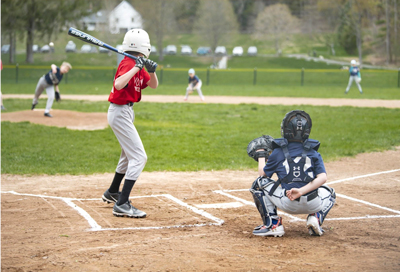
NBA player, Abe Rojansky, at bat

NBA player, Abe Rojansky, at bat

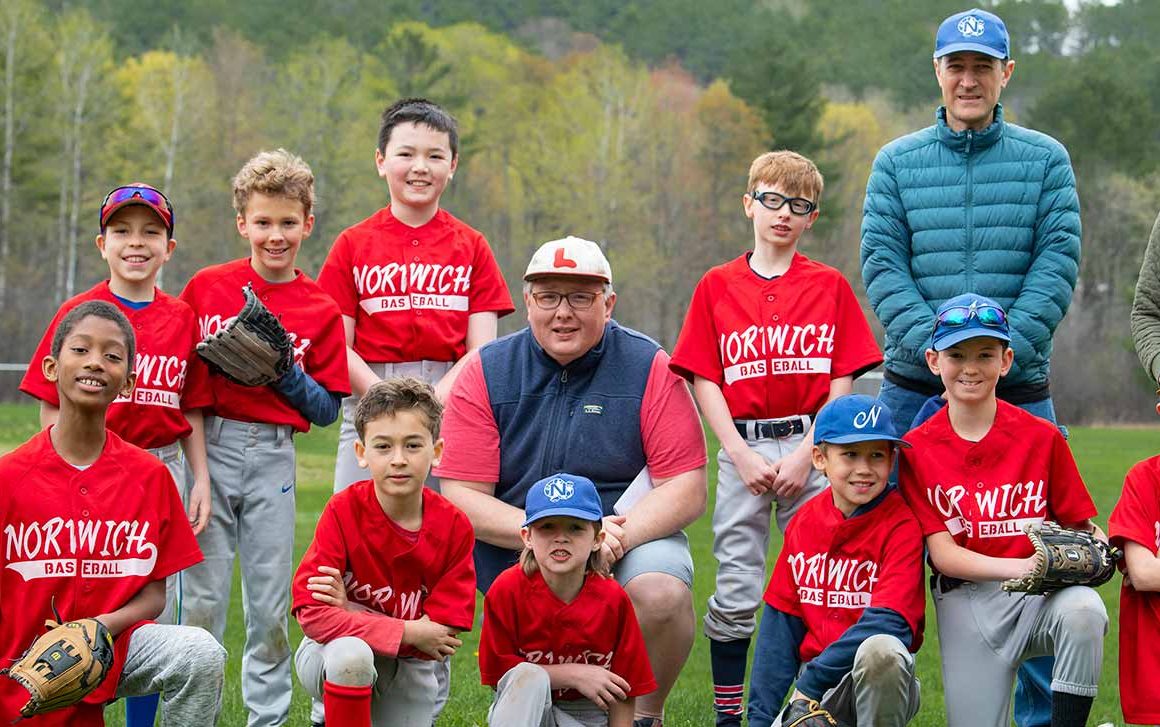
The baseball parents here in Norwich have witnessed that phenomenon firsthand. The Norwich Baseball Association (NBA), created in 2017 by Rob Kramer and now run by President Michael Costa and fellow Norwich Baseball Association board members, ensures that kids in Norwich between ages 8-12 will have the opportunity to play, improve, and learn to love the game of baseball now and in the future.

With a season beginning in early spring and practices and games running through fall, Norwich’s Cal Ripken teams are able to participate in baseball opportunities throughout most of the year. In the spring, two to three 10U (ages 8-10) and two 12U (ages 10-12) Norwich teams play against other local teams in the Upper Valley’s Cal Ripken League, like Hanover, Lebanon, and Hartford. As a part of the all-star program in the summer, teams practice and play against each other for a two-week period, and two teams (one 10U and one 12U) are selected to play in the Vermont Cal Ripken State Tournament. A more relaxed summer baseball season runs from early July to mid-late August, when rising 3rd graders are typically introduced to the program. In the fall, the NBA prepares for the next spring season with weekly practices and games. Each year, between 40-60 kids participate in the Norwich Baseball Association program.

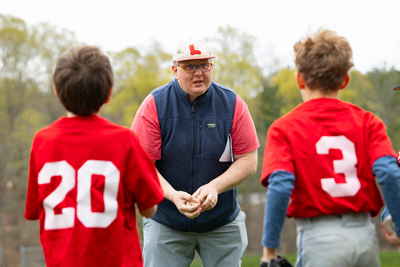
NBA president Michael Costa and two young Norwich baseball players

NBA president Michael Costa and two young Norwich baseball players

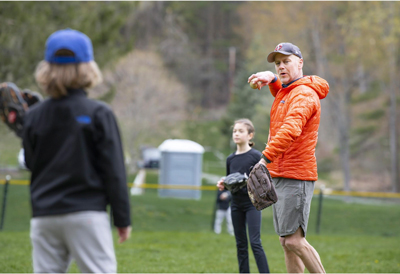
For Costa and other board members, as well as the coaches, a critical concept that the Norwich Baseball Association imparts on their teams is “player development over wins and losses,” Costa says. From the start of the season, practices are built around emphasizing good physical habits like stretching, throwing technique, base running, and more. Coaches also teach their players about the importance of good sportsmanship and being a good teammate – skills that will stick with them well beyond the baseball diamond. The coaches also challenge the players, making sure that, despite their young ages, these passionate and talented athletes are giving it their all while developing self-confidence.
“You have to really love the sport of baseball,” explains Costa. “I always tell my players, when they see a curveball for the first time, that the process of figuring out how to hit a curveball will show how much they actually love the sport.”

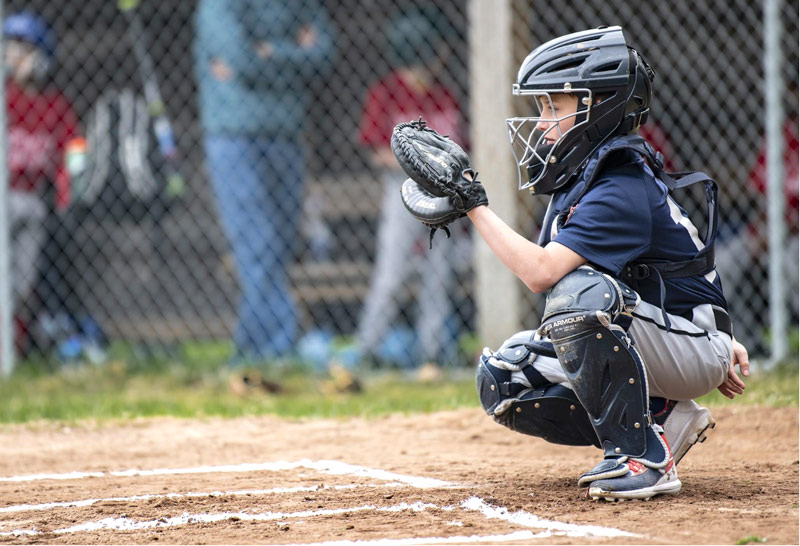
Weston Dyke catching

Weston Dyke catching

While these skills and tweaks take time to learn and improve upon, especially for younger players who are newly introduced to the sport of baseball, Costa says that seeing his players get over hurdles and demonstrate the skills they’ve been practicing is one of the best parts of his involvement with the Norwich Baseball Association.

“Sometimes it doesn’t [seem] like the kids are improving, but then they’ll make a play we had worked on in practice during the games,” remarks Costa with a hint of satisfaction.

An emphasis on teaching the fundamentals of baseball, as well as the evident time and effort put into making the NBA possible, all stems from the fact that the people involved in organizing the association are avid baseball lovers themselves. Costa was born into a baseball family, with his childhood often consumed by the sound of Red Sox radio broadcasts. “My grandfather taught my dad how to play baseball, and my dad taught me, so it’s been passed down the family,” he says. With fond memories of famous Red Sox moments – like the Dave Roberts steal in the 2004 ALC (American League Championship), which Costa considers his favorite Red Sox moment – Costa is someone who can talk about baseball for hours on end. His love for baseball extends to his work with the association between practices, schedules, and even jerseys that he pitches in to meticulously plan out.

Christopher Coughlin coaching Norwich baseball

Christopher Coughlin coaching Norwich baseball

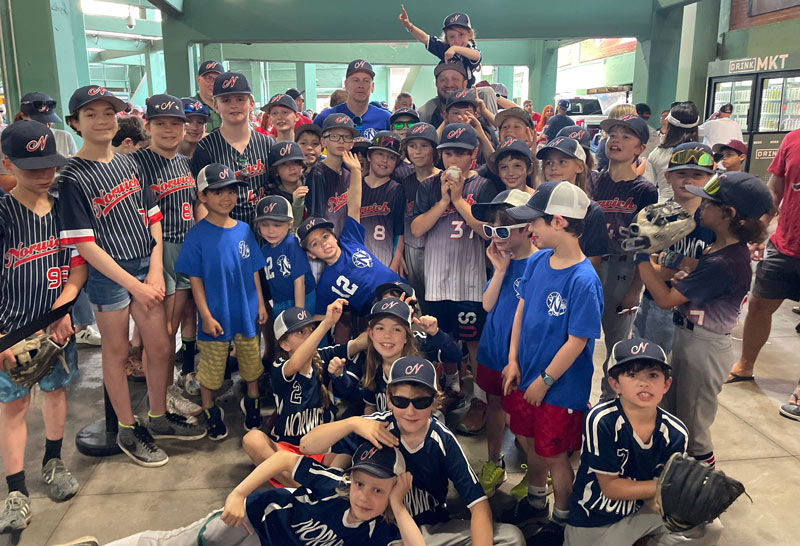
Another vital component of the Norwich Baseball Association are parent-volunteers. As Costa puts it, “None of the magic in youth sports happens without parents putting in effort.” Aside from encouraging players to focus on baseball outside of NBA-led practices and games, which Costa says is essential for the improvement of young baseball athletes, parents often help in other ways as well. Recently, NBA parents Mara Child and Lucy Rojansky, along with other parents and the board, organized a Fenway Park trip for the whole NBA community. The NBA, being a 501(c)3 non-profit organization, can do its own fundraising, and Child, seeing an opportunity that the Red Sox advertised, took the initiative to contact them, which led to both a fundraising and an educational opportunity for the NBA, allowing kids, family, and friends to enjoy a professional baseball game at one of the oldest baseball stadiums in the country. As part of the program with the Red Sox, the NBA raised around 16-1700 dollars by reselling tickets. At Fenway, the NBA players were also able to run around on the field and take pictures, making for a forgettable experience.

Like Costa, Child also grew up in a baseball family. She grew up in New Hampshire, watching and listening to Red Sox games, with distinct memories of her grandmother listening to the Red Sox broadcasts frequently and keeping her own scorebooks. After moving to Seattle with her husband, Child and her family watched Mariners games as well. When the family moved back to the Upper Valley two years ago, they became involved in the NBA, with her husband coaching (Child has made a few coaching cameos as well) and her son playing.

As a parent, Child says the NBA is a good way for her kid to connect with other players his age, but also a good way for her to connect with other baseball-inclined families.

“The Norwich Baseball Association is a great way to meet new families and build community, not just in Norwich, but also in towns across the Upper Valley,” she adds.

Norwich players of all ages celebrating Youth Sports Day at Fenway Park.

Norwich players of all ages celebrating Youth Sports Day at Fenway Park. ((Photos seen first in Demo Sofronas’ newsletter,
“About Norwich”, used with permission from aboutnorwich.substack.com.)

The NBA isn’t the only opportunity for kids to play baseball in the Upper Valley. The Upper Valley Ambush, organized by Brian Melzer, provides an opportunity for more competitive baseball in the Upper Valley. With 12U and 14U teams, Upper Valley Ambush plays in the New England Select League, which showcases some of the best youth teams across New England. Costa, who will coach one of the teams next spring, says that the Ambush allows kids to experience competitive, challenging, and travel-team-style baseball at a young age.

The Ambush also has another benefit to Upper Valley youth baseball, according to Costa.

“Upper Valley Ambush allows kids in the Upper Valley to experience travel baseball without the need to travel to Concord or Manchester to find travel baseball teams like the Concord Cannons or the New Hampshire Bobcats, like one used to have to do,” he says. Because the Ambush includes a 14U team, some games are played on a major-league-sized field, with 40′ vs. 60′ pitching mounds, 60′ vs. 90′ base paths, and overall bigger outfields, which is often a big jump for players who are used to a smaller setup. Costa explains that this is why the fundamentals of baseball are so important to learn at a young age when practicing.

Costa hopes to keep the Norwich Baseball Association going strong even after this batch of athletes moves on to the next stage of their baseball careers. “Our goal is to make this whole process sustainable so that the next group of parents who take over the program don’t have to start from scratch,” he says.

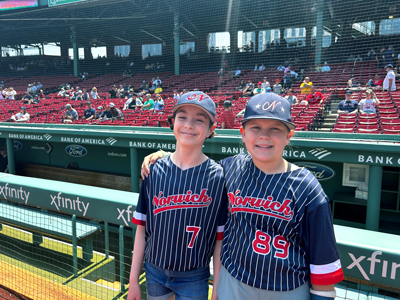
Mia Tesone and Etta Regan at Fenway Park.

Mia Tesone and Etta Regan at Fenway Park.

The Norwich Baseball Association has always been an organization passed down among parents. When founder Rob Kramer was in charge, Costa often helped out, noticing Kramer’s dedication to making quality youth baseball available to Norwich youths. Costa, now president of the association’s board, continues to try to imitate that same rigor, along with the rest of the board, coaches, and parents, who are all essential parts of the organization to keep it running smoothly.

A strong youth baseball program has many benefits that impact beyond the players and their families. At the high school level, many of the players who are on the team start off at programs such as the Norwich Baseball Association. In the case of Hanover High School, a good number of the players in the high school program played baseball in Norwich at some point. Having a strong program like the NBA ensures that the future of baseball for youth in Norwich and beyond will be rewarding in the upcoming years.

As summer turns into fall, be ready to see young baseball players in Norwich donning their navy blue jerseys as they begin their fall season. Play ball!

*****

All photos on this page except for last 2 by Kata Sasvari

Share:
Reading time: 8 min
All, Cover Story

Norwich Resident Takes the Helm at VINS

by Devin Gifford No Comments

In April of this year, the Vermont Institute of Natural Science (VINS) welcomed a new executive director, Alden Smith. Having moved to Norwich in 2022, Smith has been working to be the leader that VINS needs, while he, his wife, Missy, and their three children continue to settle into their home on Church Street.

Smith directed the Mountain School of Milton Academy in Vershire for two decades, so he and his family have lived in the Upper Valley for a long time. Smith described Vershire as a “remote, beautiful place” and a wonderful community for his children. However, he and Missy made the decision to move to Norwich in order to give their children, who are now 9, 13 and 15 years old, closer access to their various passions. Whether it was piano lessons or soccer practice, the remote location of Vershire ultimately made it more difficult for them to commute their children to the many opportunities found in the Upper Valley.

Alden Smith and his family enjoying the Norwich Town Forest

Alden Smith and his family enjoying the Norwich Town Forest

When Smith left the Mountain School, he didn’t know what his next career step would be. They spent their first year living in Norwich, unsure of whether or not they would be able to stay, but that didn’t keep them from falling in love with the vibrant community. “We traveled and interviewed all over the east, looking for new jobs and places to live, and we never found anywhere as wonderful as the neighborhood we live in right now, in Norwich,” Smith explains.

They found their new community in Norwich to be an intersection of access to both the arts and the natural world. Smith and his family love the trails, the farmers’ market, the wildlife, and the walkable nature of Norwich. Smith recalls that “the first Halloween shocked and delighted us.” After living thirty minutes from the nearest stoplight in Vershire, moving to Church Street put the family smack in the middle of the Norwich community. He remembers the trick or treaters coming to his door in droves, and how wonderful it was to host guests and be welcomed into the neighborhood.

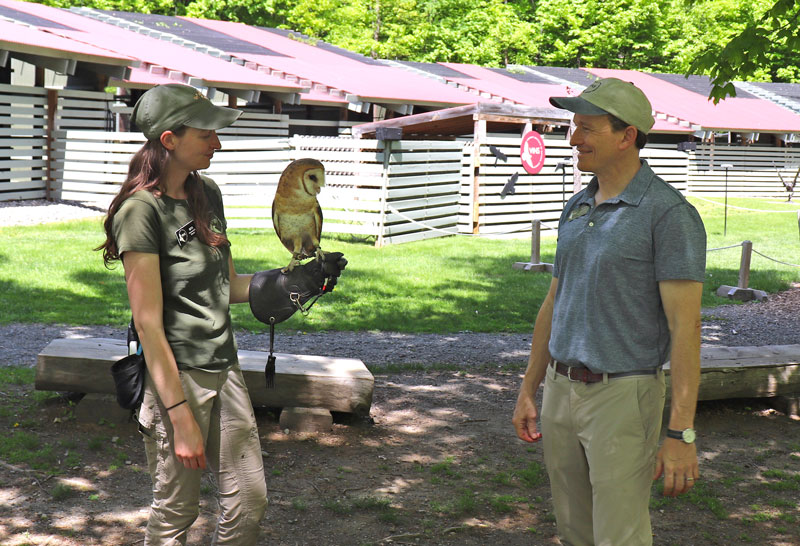
VINS executive director Alden Smith admires a barn owl perched on the arm of a handler.

VINS executive director Alden Smith admires a barn owl perched on the arm of a handler.

While Smith says the “walkable, bikeable access to community” was one of the highlights of his initial experience moving to Norwich, he also cited the connection to nature as part of the reason his family chose to make Norwich their home. He calls the slice of woods behind their home a “pocket of serenity.”

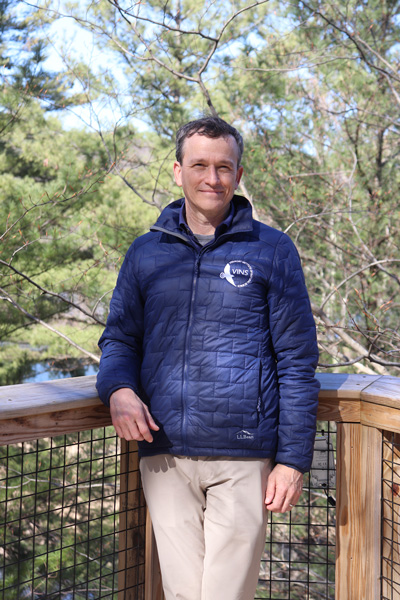
Norwich resident Alden Smith, the new Executive Director of the Vermont Institute of Natural Science.

Norwich resident Alden Smith, the new Executive
Director of the Vermont Institute of Natural Science.

“In some ways, it’s been surprising how many wild places exist down valley in Norwich, which I used to think of as a population center,” Smith says. While he misses the deep forests of Vershire, he’s finding that Norwich has more in common with his previous home than he had first thought. He and his family have been enjoying harvesting mushrooms, hiking, and biking in the woods so far over the past two years.

Smith also enjoys bow hunting, which has been one way that he’s gotten familiar with the woods of Norwich since moving here. He acknowledged that being a hunter might seem to be in tension with his conservation work at VINS, but he views his hunting as a conservation effort in itself: “While Norwich is diverse and healthy, an overpopulation of deer is not good for biodiversity.”

So, despite their extensive job search, the Smith family hoped a job opportunity would emerge in the Upper Valley. Smith’s position at VINS provided a perfect opportunity for them to stay in Norwich.

Smith has been settling in well as the new executive director of VINS, applying the nonprofit management skills he learned at the Mountain School – a semester program for juniors located on a farm with a focus on connecting to nature and to each other. He was drawn to VINS by its mission to inspire people to care for the natural world. Living and promoting this mission, he says, requires simply that he be the “most authentic version” of himself.

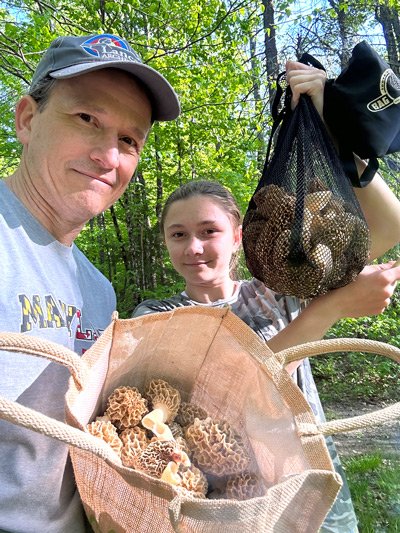
Alden and his daughter Ellicott harvest morel mushrooms in the Upper Valley woods

Alden and his daughter Ellicott harvest morel mushrooms in the
Upper Valley woods

He finds the work fun and restorative. “Even if I’m having a bad day in the office, I can go visit the snowy owls or climb the canopy tower and look out on the Ottauquechee River,” he explains. For Smith, VINS is an extraordinary place to work and learn, and he feels lucky to have found his “work home” there.

While his long-term goal is to expand the impact that VINS has in the community, Smith remarked that he’s taking it slow and learning from all that VINS has to offer. “Right now, we are launching a strategic planning process that taps into deep wisdom within the organization,” he says. The next steps that Smith envisions for VINS hearken back to its origin story: in 1970, VINS founders David and Sally Laughlin led an effort to clean up the then-polluted Ottauquechee River and continued their conservation efforts from there, resulting in the creation of VINS in 1972. “We’re really interested in circling back to that original vision, especially the ways that clean water connects and heals us,” Smith says.

Smith thinks of this story each time he climbs to the top of the canopy tower. “I look down at the Ottauquechee River, which is about two football fields away and 100 feet below, and I can see down through that clean river to the stones at the bottom,” he explains. Smith views this clarity of water both as a testament to the Laughlins’ vision and as a call to continue the effort to heal and protect the Upper Valley.

Alden and his son, Alden Hopkins, in the Norwich woods on Youth Hunting Weekend

Alden and his son, Alden Hopkins, in the Norwich woods on
Youth Hunting Weekend

So Smith’s priority is to apply the rich history of VINS to the needs of the present. “We give people an opportunity to see what is present but often invisible in nature,” he says. From locking eyes with a Golden Eagle to walking through the top of the tree canopy, visitors discover unique perspectives on the natural world. Smith hopes that the community is inspired by these experiences to take action and protect the environment. He acknowledges that VINS would not exist without the community. VINS is supported by a devoted group of volunteers, many of whom have been with VINS for decades, and the institute welcomes new volunteers every year. Local schools and camps visit VINS, giving them the opportunity to educate young people, and the nonprofit relies on funding from many people and organizations throughout the Upper Valley.

“We’re grateful at VINS to do the work we do, and to help the Upper Valley be a healthier place to live and learn,” Smith says.

Share:
Reading time: 5 min
All, Cover Story

A Life With Horses: The Princes’ Story

May 28, 2024 by Paul Foster No Comments
Toni Prince doing what she loves on her horse farm.

Sometimes it feels like things don’t change, until they do. Generations of children have grown up in Union Village, and many have enjoyed the routine of a walk to see the horses at the Gregory and Toni Prince’s farm. But this year – both at the age of 84 – the Princes decided to sell their farmhouse and land.

“In hindsight, we probably should have done this two or three years ago,” Gregory said. “All the chores and upkeep of the farm were proving too much for us.” Many times, in the middle of winter, in the snow, you would see Gregory out mending fences or moving manure with his tractor. He would always be so welcoming and friendly, though you could tell he must have been freezing. “Our grown children have been pushing us for a while to downsize,” he added.

The Princes’ homestead is an idyllic landmark that shouts “rural Vermont” and welcomes you to Union Village in Norwich. Since 1970, when Gregory and Toni Prince bought their horse farm, Toni has been teaching generations of local young people to ride.

Toni Prince doing what she loves on her horse farm.

Horses have always been a huge part of Toni’s life. She started teaching horseback riding at ten years old in her home state of Virginia. Toni ended up not finishing college; instead, she focused on building a very successful business as a riding instructor for youth. Many of her students over the years have gone on to win championships and compete at high levels in various competitions.

When the Princes recently sold their farmhouse and the land and paddocks to the family of a builder, he built them a very cute little house right next to their old one. It has panoramic views of the horse pastures and the cows up over the Connecticut river on Campbell Flats. It has a screened-in porch and will soon have an outdoor patio. The house is filled with Toni’s antiques and is like a mini version of the main house they just sold. The one missing element is a Golden Labrador. Over the years, Gregory and Toni have had several Labradors; they would wander out to the road as visitors walked by. The pair aren’t sure if they will get another dog, though it is hard to imagine the Princes without one.

Gregory and Toni Prince in their new home

I went to visit the Princes in their new home. I have known them for over forty years. Both of my daughters learned how to ride with Toni. My youngest daughter, Katie, said, “I have always thought she is such a kind woman and have been amazed by her dedication to her horses and to teaching children to love horses as she does. Her love for her horses is infectious and she grew a love for horses in me. She is someone I will always remember.”

When I arrived, they were sitting by a lovely fire in their new home. They appeared very comfortable in their new surroundings. There is a wonderful chemistry between the two – a real affection for each other. They are childhood sweethearts, after all.

When the Princes came to Norwich together in their early 20s, they had opened a new chapter in their lives on the farm. They’ve now been together for over 60 years, and as one chapter closes, another one opens. I asked them what led them to sell their farm but stay nearby. Toni was adamant that she was not going to go into senior housing; she wanted to “age in place”. They had sold two of the horses to the new owners of the farm, but were keeping two.

Gregory, on the other hand, felt that he would have been quite content to move into a senior living community. He is perhaps the more outgoing and social one of the couple, and he may have found the social opportunities of a senior home stimulating. Over the years, Gregory has been a facilitator, helping Toni with the farm and the horses. He’s not as passionate about horses as Toni, but as Toni’s riding business helped fund Gregory’s intellectual pursuits at Stanford and Yale, he shows his appreciation by being a real trooper – helping with a lot of the chores and standing by Toni’s side.

Gregory mentions a recent article he read about the problem of older Americans aging in large houses that they could no longer keep up. For the Princes, it was not so much the upkeep of the house, but all of the upkeep needed to keep the horse farm operational. 

Coco Yehle practicing her jumping at the Princes’ farm

One of Toni’s favorite hobbies is collecting antiques. She manages two booths, one in Quechee and one in Chester, Vermont. The old house was always full of beautiful antiques and many of them adorn the new house. “The [antique] business has really changed. So much of it is now online and some of the prices are outrageous,” Toni said. The basement of the new house is where Toni keeps her antique acquisitions.

Gregory has had a life in academia. He directed summer programs at Dartmouth College, was the president of Hampshire College, and published a book on education. He is still active as a Board member of a Charter School in Washington, D.C., and he holds some strong opinions on the profession of education and the lack of support for front line workers (worthy of another article).

I talked with the Princes about how Union Village has changed in the 54 years since they moved here. They told me about the old store in Union Village and the dance hall. There have been very few new buildings in the Village since– Bernie Benn’s house being the only one we could think of. “There have been decades when there were hardly any children in the Village. Now, this Halloween, as the Princes handed out goodies to the neighborhood children, they witnessed just how many youngsters live in the village – 11 and counting, said Toni.

Toni has touched the hearts and minds of hundreds of young children during her time teaching. Ella Swett, a Norwich resident and a freshman at Kimball Union Academy, has been a riding student of Toni’s since she was seven. Ella has been riding Adonis, who came to the Princes’ stables after a difficult life. I put Ella on the spot and asked her what she liked about Toni’s teaching style.

Ella Swett started riding with Toni Prince at age 7

“Well, I think Mrs. Prince teaches in a way that you suddenly realize what you have learned. It’s not really a trick but it’s not always immediately apparent what you are learning,” she said. “I think she commands respect and in turn gives it. She provides a safe environment in which to learn and grow – a home away from home. She definitely inspires us and she is one of the people I most admire in the world. She has high expectations of us that push us to learn and grow.”

Ella thinks that horses will probably be in her future life in some capacity. She doesn’t think she will compete, but she has a love of working with rescue horses and gaining their trust and confidence.

Coco Yehle is the 12-year-old daughter of the family moving into the Princes’ house and farm. Her father built the Princes’ new home and plans to remodel the old farmhouse.

“I’ll wake up every morning and be able to look out and see the horses,” Coco said with excitement. Coco’s mother, Crystal Piffath, will be co-teaching with Toni. Coco has no concerns about the transition; she loves taking care of the horses working with Toni who gives her great advice. Coco loves jumping and has a goal to compete in the Olympics, and she would also love to own a breeding and lesson farm someday.

There is no doubt that Toni Prince has had a profound impact on these two young ladies and all of her riding students over the years.

Ella with her favorite horse, Adonis

As a new chapter unfolds for the Princes, Gregory acknowledges that it’s a little scary. Touch wood, they are both relatively healthy. Gregory was acutely ill a few years ago and had the good fortune to be able to use the services of the local emergency squad and the community nurse. Toni has had some joint replacements and broke her foot. As more elderly Vermonters decide to “age in place”, vital services like a community nurse, community transportation, and care services are important resources to lean on. Toni and Gregory are still able to drive, and they have the love and support of friends and their two grown children. And, when they look out the windows of their new home, the Princes will still see their four legged friends in the paddocks just over yonder.

Share:
Reading time: 7 min
All, Cover Story

Contra Dancing Culture in Norwich Continues Following a Caller’s Passing

by Gwynn Lyons No Comments
Blind Squirrel, featuring Upper Valley musicians Bill Shepard, Erin Smith, and Steve Hoffman (fiddle); Suzanne Long (fiddle and cello); and Chip Hedler (guitar).

On many a Saturday night at Tracy Hall, dancers can be found moving to one of the Upper Valley region’s several contradance bands. Joined by a “caller” who choreographs the dancers, the bands invoke a variety of musical traditions, from Appalachian and Celtic to old English and French Canadian.

One man who contributed significantly to the Norwich contradance scene was the late Chip Hedler. Chip was the guitarist for the band Blind Squirrel, which regularly performed in Norwich. Alongside one of his bandmates, Erin Smith, he was also a member of the Norwich Dance Committee, a small group that works together to plan community dances throughout the year.

Performing with the band Blind Squirrel, Chip Hedler embodied the
essence of the Upper Valley’s contradance community: openness,
enthusiasm, and generosity of spirit.

Performing with the band Blind Squirrel, Chip Hedler
embodied the essence of the Upper Valley’s contradance
community: openness, enthusiasm, and generosity of spirit.

The group got together in 2015, when two of the local contradance bands that had been going for years – Northern Spy and Cuckoo’s Nest – decided to stop undertaking the organizing of the events by themselves.

The idea was, “if you want [the dances] to continue, you have to participate and be willing to step up and take a leadership role,” Erin said. “I think everybody had been coasting along and enjoying letting someone else do it, so there was a learning curve figuring out how to run it.”

Chip was ready to take up the challenge. As part of his duties, he maintained the Dance Committee’s website, made posters, and booked talent for dances. He also helped plan the summer series at East Thetford’s Pavilion.

“Chip was crucial to keeping things going,” Erin said. “He [was] part of the committee since it started and he [was] just always willing to step up and do things when needed, [was] really supportive of new dancers when they come, and eager to be a better musician.”

One of Blind Squirrel’s last dances with Chip was in February. Erin remembers a humorous moment Chip had with a vibraslap – a percussion instrument commonly found in Latin music. Chip was stomping his foot right next to a music stand that the vibraslap was balanced on. He accidentally toppled the music stand and the vibraslap fell over and sounded off, causing the whole room to turn and look to see what happened. Everyone in the band was laughing, but they had to keep playing – the show had to go on!

Calling Contra Dances in Norwich & Beyond

Chip also was a dedicated caller who would travel far and wide to call for contra dances in New England. The week before his death in March, Chip and former Blind Squirrel bandmate, Steve Hoffman, went to the Saint Patrick’s Day gathering in Littleton, New Hampshire.

Steve recalled, “He would go just about anywhere to call a dance.” He credited Chip’s professional background as a teacher with his ability to engage audiences. “Being a teacher, I think he had a good sense for that.” Chip taught elementary and middle school in the Danville area at some of the last one-room schoolhouses in Vermont.

Veteran caller David Millstone has over 30 years of experience performing in the band Northern Spy that regularly played in Norwich. He says callers need to be well-rounded, sensitive and responsive, and good communicators. They “need to be able to read a crowd, knowing when to introduce simple, basic figures, and when they can introduce a little more complexity or challenge into an evening,” he wrote in an email to the Norwich Times.

Dancers take to the floor at Tracy Hall during a contra dance in February.

Dancers take to the floor at Tracy Hall during a contra dance in February.

What David most enjoys about calling was “the sense of helping create an enjoyable evening for everyone by picking the right dances for that particular group of people, working closely with the band to find the right mix of tunes and letting them sound their best, choreographing the evening so that everyone goes away having had a good time,” he said.

Chip excelled at setting the mood for dances. He “[helped] everyone feel comfortable and relaxed, whether they be new dancers or new musicians…he was a welcoming and supportive presence,” David added.

The History of Contra dance in the UV

Beyond Blind Squirrel, numerous contra dance bands have graced the Upper Valley region since the resurgence of the art form in the early 70s, including Northern Spy, Cuckoo’s Nest, Smash the Windows, and Dr. Ruth and the Pleasure Seekers.

Blind Squirrel

Blind Squirrel

According to David, renowned caller Dudley Laufman re-launched the dance genre locally, in South Strafford’s Barrett Hall. A new band, Smash the Windows, emerged in the late 70s, holding monthly dances in Lyme, then in Lebanon and Cornish.

Northern Spy, David’s band, first performed in Lebanon, then Etna, before settling at Norwich’s Tracy Hall. At the early dances, sometimes the band members would outnumber the dancers, but by the late 80s, attendance at Tracy Hall contra dances numbered up to 200.

“The popularity waxed and waned, and by the 20-teens, when a committee took responsibility for organizing the Norwich dances…attendance had fallen below 50,” David added. The coronavirus made dancing impossible for a while, but “the Norwich dance now is on the rise with many new, younger dancers discovering this healthy and friendly activity and bringing their friends.”

Looking to the Future

Since the retirement of Northern Spy and Cuckoo’s Nest, the Norwich Dance Committee has been able to engage other regional bands and provide more variety for dancers with different styles of music. Blind Squirrel is looking to restart by finding a new guitar player. “That’s what [Chip] would have wanted,” said Erin.

Elfie Forbes, a long-time contra dancer and Norwich resident, is grateful for the continued efforts of the committee. “I’m glad [dancing] keeps going here,” she said. For her, dancing helps build an in-person community in a world that feels fractured and disconnected, and it’s a great way to meet people. Elfie’s late partner, Ruth Sylvester, was a caller at Norwich dances for many years.

Chip at one of his last dances in New London before his passing in March.

Chip at one of his last dances in New London before his
passing in March.

Contra dancing is fun for the musicians, too. “It’s a great feeling” to provide the music for the dancers, Steve said. The pressure is off because “you’re there playing in front of people, but you’re not performing. The people dancing are so focused on the caller, so we’re playing for ourselves and the dancers.”

That ethic of service was certainly evident in the way Chip supported his bandmates and his community. He’ll be remembered for his generosity, caring nature, dedication, and humility by those who continue to be connected to the contra dance tradition and beyond.

Share:
Reading time: 5 min
Page 2 of 10«1234»10...Last »

Our Latest Issue

Fall 2026 Edition

© 2024 copyright Greater Good Media. All rights reserved.