Home
About Norwich
Our Team
Content
    All Articles
    Cover Story
    Animals Rule!
    Around Town
    Artist Profile
    Creating Community
    Elder Profile
    Green Page
    Goodness InDeed
    History
    Life at 531 Feet
    Meet your Neighbor
    School Days
    Your Green Spaces
Our Sponsors
Advertise
Archives
Contact Us

Norwich Times - Good People, Good Places, Good Things Happening
  • Home
  • About Norwich
  • Our Team
  • Content
    • All Articles
    • Cover Story
    • Animals Rule!
    • Around Town
    • Artist Profile
    • Creating Community
    • Elder Profile
    • Green Page
    • Goodness InDeed
    • History
    • Life at 531 Feet
    • Meet your Neighbor
    • School Days
    • Your Green Spaces
  • Our Sponsors
  • Advertise
  • Archives
  • Contact Us
All, Cover Story

A Life With Horses: The Princes’ Story

May 28, 2024 by Paul Foster No Comments
Toni Prince doing what she loves on her horse farm.

Sometimes it feels like things don’t change, until they do. Generations of children have grown up in Union Village, and many have enjoyed the routine of a walk to see the horses at the Gregory and Toni Prince’s farm. But this year – both at the age of 84 – the Princes decided to sell their farmhouse and land.

“In hindsight, we probably should have done this two or three years ago,” Gregory said. “All the chores and upkeep of the farm were proving too much for us.” Many times, in the middle of winter, in the snow, you would see Gregory out mending fences or moving manure with his tractor. He would always be so welcoming and friendly, though you could tell he must have been freezing. “Our grown children have been pushing us for a while to downsize,” he added.

The Princes’ homestead is an idyllic landmark that shouts “rural Vermont” and welcomes you to Union Village in Norwich. Since 1970, when Gregory and Toni Prince bought their horse farm, Toni has been teaching generations of local young people to ride.

Toni Prince doing what she loves on her horse farm.

Horses have always been a huge part of Toni’s life. She started teaching horseback riding at ten years old in her home state of Virginia. Toni ended up not finishing college; instead, she focused on building a very successful business as a riding instructor for youth. Many of her students over the years have gone on to win championships and compete at high levels in various competitions.

When the Princes recently sold their farmhouse and the land and paddocks to the family of a builder, he built them a very cute little house right next to their old one. It has panoramic views of the horse pastures and the cows up over the Connecticut river on Campbell Flats. It has a screened-in porch and will soon have an outdoor patio. The house is filled with Toni’s antiques and is like a mini version of the main house they just sold. The one missing element is a Golden Labrador. Over the years, Gregory and Toni have had several Labradors; they would wander out to the road as visitors walked by. The pair aren’t sure if they will get another dog, though it is hard to imagine the Princes without one.

Gregory and Toni Prince in their new home

I went to visit the Princes in their new home. I have known them for over forty years. Both of my daughters learned how to ride with Toni. My youngest daughter, Katie, said, “I have always thought she is such a kind woman and have been amazed by her dedication to her horses and to teaching children to love horses as she does. Her love for her horses is infectious and she grew a love for horses in me. She is someone I will always remember.”

When I arrived, they were sitting by a lovely fire in their new home. They appeared very comfortable in their new surroundings. There is a wonderful chemistry between the two – a real affection for each other. They are childhood sweethearts, after all.

When the Princes came to Norwich together in their early 20s, they had opened a new chapter in their lives on the farm. They’ve now been together for over 60 years, and as one chapter closes, another one opens. I asked them what led them to sell their farm but stay nearby. Toni was adamant that she was not going to go into senior housing; she wanted to “age in place”. They had sold two of the horses to the new owners of the farm, but were keeping two.

Gregory, on the other hand, felt that he would have been quite content to move into a senior living community. He is perhaps the more outgoing and social one of the couple, and he may have found the social opportunities of a senior home stimulating. Over the years, Gregory has been a facilitator, helping Toni with the farm and the horses. He’s not as passionate about horses as Toni, but as Toni’s riding business helped fund Gregory’s intellectual pursuits at Stanford and Yale, he shows his appreciation by being a real trooper – helping with a lot of the chores and standing by Toni’s side.

Gregory mentions a recent article he read about the problem of older Americans aging in large houses that they could no longer keep up. For the Princes, it was not so much the upkeep of the house, but all of the upkeep needed to keep the horse farm operational. 

Coco Yehle practicing her jumping at the Princes’ farm

One of Toni’s favorite hobbies is collecting antiques. She manages two booths, one in Quechee and one in Chester, Vermont. The old house was always full of beautiful antiques and many of them adorn the new house. “The [antique] business has really changed. So much of it is now online and some of the prices are outrageous,” Toni said. The basement of the new house is where Toni keeps her antique acquisitions.

Gregory has had a life in academia. He directed summer programs at Dartmouth College, was the president of Hampshire College, and published a book on education. He is still active as a Board member of a Charter School in Washington, D.C., and he holds some strong opinions on the profession of education and the lack of support for front line workers (worthy of another article).

I talked with the Princes about how Union Village has changed in the 54 years since they moved here. They told me about the old store in Union Village and the dance hall. There have been very few new buildings in the Village since– Bernie Benn’s house being the only one we could think of. “There have been decades when there were hardly any children in the Village. Now, this Halloween, as the Princes handed out goodies to the neighborhood children, they witnessed just how many youngsters live in the village – 11 and counting, said Toni.

Toni has touched the hearts and minds of hundreds of young children during her time teaching. Ella Swett, a Norwich resident and a freshman at Kimball Union Academy, has been a riding student of Toni’s since she was seven. Ella has been riding Adonis, who came to the Princes’ stables after a difficult life. I put Ella on the spot and asked her what she liked about Toni’s teaching style.

Ella Swett started riding with Toni Prince at age 7

“Well, I think Mrs. Prince teaches in a way that you suddenly realize what you have learned. It’s not really a trick but it’s not always immediately apparent what you are learning,” she said. “I think she commands respect and in turn gives it. She provides a safe environment in which to learn and grow – a home away from home. She definitely inspires us and she is one of the people I most admire in the world. She has high expectations of us that push us to learn and grow.”

Ella thinks that horses will probably be in her future life in some capacity. She doesn’t think she will compete, but she has a love of working with rescue horses and gaining their trust and confidence.

Coco Yehle is the 12-year-old daughter of the family moving into the Princes’ house and farm. Her father built the Princes’ new home and plans to remodel the old farmhouse.

“I’ll wake up every morning and be able to look out and see the horses,” Coco said with excitement. Coco’s mother, Crystal Piffath, will be co-teaching with Toni. Coco has no concerns about the transition; she loves taking care of the horses working with Toni who gives her great advice. Coco loves jumping and has a goal to compete in the Olympics, and she would also love to own a breeding and lesson farm someday.

There is no doubt that Toni Prince has had a profound impact on these two young ladies and all of her riding students over the years.

Ella with her favorite horse, Adonis

As a new chapter unfolds for the Princes, Gregory acknowledges that it’s a little scary. Touch wood, they are both relatively healthy. Gregory was acutely ill a few years ago and had the good fortune to be able to use the services of the local emergency squad and the community nurse. Toni has had some joint replacements and broke her foot. As more elderly Vermonters decide to “age in place”, vital services like a community nurse, community transportation, and care services are important resources to lean on. Toni and Gregory are still able to drive, and they have the love and support of friends and their two grown children. And, when they look out the windows of their new home, the Princes will still see their four legged friends in the paddocks just over yonder.

Share:
Reading time: 7 min
All, Cover Story

Contra Dancing Culture in Norwich Continues Following a Caller’s Passing

by Gwynn Lyons No Comments
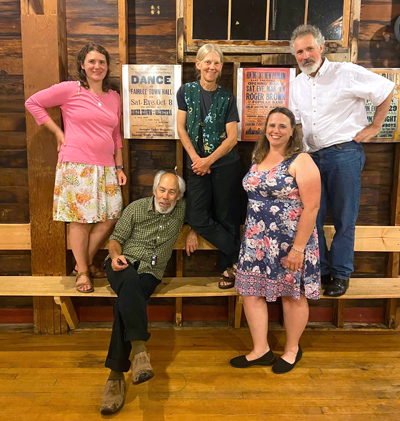
Blind Squirrel, featuring Upper Valley musicians Bill Shepard, Erin Smith, and Steve Hoffman (fiddle); Suzanne Long (fiddle and cello); and Chip Hedler (guitar).

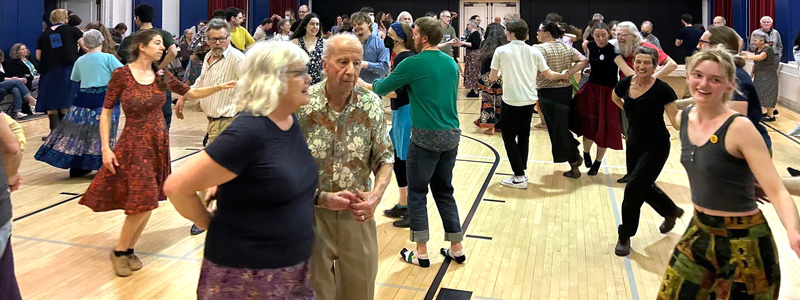
On many a Saturday night at Tracy Hall, dancers can be found moving to one of the Upper Valley region’s several contradance bands. Joined by a “caller” who choreographs the dancers, the bands invoke a variety of musical traditions, from Appalachian and Celtic to old English and French Canadian.

One man who contributed significantly to the Norwich contradance scene was the late Chip Hedler. Chip was the guitarist for the band Blind Squirrel, which regularly performed in Norwich. Alongside one of his bandmates, Erin Smith, he was also a member of the Norwich Dance Committee, a small group that works together to plan community dances throughout the year.

Performing with the band Blind Squirrel, Chip Hedler embodied the
essence of the Upper Valley’s contradance community: openness,
enthusiasm, and generosity of spirit.

Performing with the band Blind Squirrel, Chip Hedler
embodied the essence of the Upper Valley’s contradance
community: openness, enthusiasm, and generosity of spirit.

The group got together in 2015, when two of the local contradance bands that had been going for years – Northern Spy and Cuckoo’s Nest – decided to stop undertaking the organizing of the events by themselves.

The idea was, “if you want [the dances] to continue, you have to participate and be willing to step up and take a leadership role,” Erin said. “I think everybody had been coasting along and enjoying letting someone else do it, so there was a learning curve figuring out how to run it.”

Chip was ready to take up the challenge. As part of his duties, he maintained the Dance Committee’s website, made posters, and booked talent for dances. He also helped plan the summer series at East Thetford’s Pavilion.

“Chip was crucial to keeping things going,” Erin said. “He [was] part of the committee since it started and he [was] just always willing to step up and do things when needed, [was] really supportive of new dancers when they come, and eager to be a better musician.”

One of Blind Squirrel’s last dances with Chip was in February. Erin remembers a humorous moment Chip had with a vibraslap – a percussion instrument commonly found in Latin music. Chip was stomping his foot right next to a music stand that the vibraslap was balanced on. He accidentally toppled the music stand and the vibraslap fell over and sounded off, causing the whole room to turn and look to see what happened. Everyone in the band was laughing, but they had to keep playing – the show had to go on!

Calling Contra Dances in Norwich & Beyond

Chip also was a dedicated caller who would travel far and wide to call for contra dances in New England. The week before his death in March, Chip and former Blind Squirrel bandmate, Steve Hoffman, went to the Saint Patrick’s Day gathering in Littleton, New Hampshire.

Steve recalled, “He would go just about anywhere to call a dance.” He credited Chip’s professional background as a teacher with his ability to engage audiences. “Being a teacher, I think he had a good sense for that.” Chip taught elementary and middle school in the Danville area at some of the last one-room schoolhouses in Vermont.

Veteran caller David Millstone has over 30 years of experience performing in the band Northern Spy that regularly played in Norwich. He says callers need to be well-rounded, sensitive and responsive, and good communicators. They “need to be able to read a crowd, knowing when to introduce simple, basic figures, and when they can introduce a little more complexity or challenge into an evening,” he wrote in an email to the Norwich Times.

Dancers take to the floor at Tracy Hall during a contra dance in February.

Dancers take to the floor at Tracy Hall during a contra dance in February.

What David most enjoys about calling was “the sense of helping create an enjoyable evening for everyone by picking the right dances for that particular group of people, working closely with the band to find the right mix of tunes and letting them sound their best, choreographing the evening so that everyone goes away having had a good time,” he said.

Chip excelled at setting the mood for dances. He “[helped] everyone feel comfortable and relaxed, whether they be new dancers or new musicians…he was a welcoming and supportive presence,” David added.

The History of Contra dance in the UV

Beyond Blind Squirrel, numerous contra dance bands have graced the Upper Valley region since the resurgence of the art form in the early 70s, including Northern Spy, Cuckoo’s Nest, Smash the Windows, and Dr. Ruth and the Pleasure Seekers.

Blind Squirrel

Blind Squirrel

According to David, renowned caller Dudley Laufman re-launched the dance genre locally, in South Strafford’s Barrett Hall. A new band, Smash the Windows, emerged in the late 70s, holding monthly dances in Lyme, then in Lebanon and Cornish.

Northern Spy, David’s band, first performed in Lebanon, then Etna, before settling at Norwich’s Tracy Hall. At the early dances, sometimes the band members would outnumber the dancers, but by the late 80s, attendance at Tracy Hall contra dances numbered up to 200.

“The popularity waxed and waned, and by the 20-teens, when a committee took responsibility for organizing the Norwich dances…attendance had fallen below 50,” David added. The coronavirus made dancing impossible for a while, but “the Norwich dance now is on the rise with many new, younger dancers discovering this healthy and friendly activity and bringing their friends.”

Looking to the Future

Since the retirement of Northern Spy and Cuckoo’s Nest, the Norwich Dance Committee has been able to engage other regional bands and provide more variety for dancers with different styles of music. Blind Squirrel is looking to restart by finding a new guitar player. “That’s what [Chip] would have wanted,” said Erin.

Elfie Forbes, a long-time contra dancer and Norwich resident, is grateful for the continued efforts of the committee. “I’m glad [dancing] keeps going here,” she said. For her, dancing helps build an in-person community in a world that feels fractured and disconnected, and it’s a great way to meet people. Elfie’s late partner, Ruth Sylvester, was a caller at Norwich dances for many years.

Chip at one of his last dances in New London before his passing in March.

Chip at one of his last dances in New London before his
passing in March.

Contra dancing is fun for the musicians, too. “It’s a great feeling” to provide the music for the dancers, Steve said. The pressure is off because “you’re there playing in front of people, but you’re not performing. The people dancing are so focused on the caller, so we’re playing for ourselves and the dancers.”

That ethic of service was certainly evident in the way Chip supported his bandmates and his community. He’ll be remembered for his generosity, caring nature, dedication, and humility by those who continue to be connected to the contra dance tradition and beyond.

Share:
Reading time: 5 min
All, History

A Look Back

by David Callaway No Comments

“Time is a jet plane; it moves too fast.” – Bob Dylan

I started writing historical articles for the Norwich Times in the summer of 2015. After 33 journeys into Norwich history, it’s time to pass the computer, the pen, or maybe the quill onto another chronicler. Before I sign off, I’d like to revisit a few of those intriguing people, places, and events in Norwich’s history that have made their way into print. To spice things up, I’ve included a review question at the end of each passage. Answers will be at the end of the article.

Wartime Celebration in Norwich

July 4, 1944

Let’s start with a softball question: What event happened in Norwich on July 4, 1944, that drew over 400 people? The gathering opened with a rendition of “God Bless America” with Fred Metcalf accompanying on his organ. A ribbon was cut, and folks enjoyed grilled burgers and hot dogs cooked on stone fireplaces built by Ernest Fitzgerald and Dan Fraser. Kids and adults participated in races and contests. Bill Aldrich, a lifetime Norwich resident, was a small boy at the event and remembered one game that “involved drinking a Coke out of a baby bottle, and the quickest to empty was the winner.” The celebration closed with “The Star Spangled Banner.” Need a hint? Visit the Norwich Town Hall and check out the Paul Sample painting in the clerk’s office.

1. Why was there a celebration in Norwich on July 4, 1944?

  1. Celebrating the success of the D-Day invasion
  2. The opening of the town pool
  3. Birthday gala for long-time Norwich resident Verne Lundquist

Town Reports

There’s no better way to understand the history and character of Norwich than by thumbing through the town reports, which first appeared before Town Meeting Day in 1778. By the late nineteenth century, the reports covered the town’s financial health to the last penny. They explained how the village educated its children, treated its poverty-stricken citizens, and supported its local institutions year after year. Here is a question from one town report:

2. On November 13, 1963, President Kennedy signed a bill that created what landmark development?

  1. The first interstate school district in the nation, joining Norwich and Hanover
  2. The building of Interstate 91
  3. Property taxes could not be based on home value

To Save the Union

During the Civil War, 178 Norwich men, out of a population of 1,759, joined the Union Army and Navy. In September 1861, a farm worker from Norwich joined the military after he received a $100 bounty for his patriotism. This young Vermonter fought in 18 major battles, including Gettysburg and Antietam. The soldier was wounded near the end of his enlistment and sent home, where he ran a farm on Turnpike Road, married, and helped raise five children. He is buried beneath a large family tombstone in Hillside Cemetery.

3. Who was this Civil War soldier?

  1. Eldred Huff  
  2. Asa Fix
  3. Gomer Pyle 
  4. Ransom Slack

Big Business on the River

In the later part of the nineteenth century, Pattersonville, a bustling hamlet, was established on the northern edge of Norwich along the Ompompanoosuc River. Between 1872 and 1910, L. S. Patterson developed a company that was Norwich’s largest and most prosperous. The products made in Pattersonville were shipped to St. Johnsbury and Burlington and dealers in Boston, New York, Baltimore, and Philadelphia.

4. What was made in Pattersonville?

  1. Musical instruments
  2. Furniture
  3. Lumber for new homes 

Crossing the River

Since 1804, there have been six bridges across the Connecticut River between Hanover and Norwich. The first span was a toll bridge. Every walker paid two cents, and a horse and rider cost five cents. In 1859, a third bridge was constructed, covered, and free to cross. It survived a flood in 1869 and stood up to the historic 1927 flood. During the log drives in the 1890s, “logs used to jam up so badly against the old stone pier that they had to be dynamited to effect their release – but the old bridge stood.” Goods bound for Hanover were shipped to the Lewiston train station in Norwich and carted across the bridge. Many Dartmouth first-year students were dropped off at the station and “walked through the covered bridge and up the hill to view the Hanover plain for the first time.” The covered bridge lasted until 1935; today’s bridge, completed in 1999, cost $11.2 million.

5. The current Ledyard Bridge was subject to a heated debate regarding…

  1. Its lack of a proper bike path
  2. The decorative stone balls along the bridge
  3. Should the bridge be renamed after then-President Clinton

The Concrete Octopus

The Concrete Octopus

In 1964, Interstate 91, the new superhighway, approached Norwich. The state of Vermont announced its intention to build two on-ramps and two exit ramps at the shortest and most direct route between Norwich and Hanover. The proposed interstate did not sit well with the community and set off a four-year battle that included letters to the editor, petitions, and town votes. Some citizens were upset about the destruction of the hamlet of Lewiston, a small group of homes and stores on the Vermont side of the Ledyard Bridge. In contrast, others welcomed the opportunity to enjoy the benefits of a modern transportation system.

6. During the discussion about where to locate the I-91 interchange, several alternatives were suggested. Were they to:

  1. Shift the interchange to the Loveland district two miles north of the Ledyard Bridge and build a new bridge
  2. Set the interchange in the general vicinity of where Willing Hands is located today
  3. Both a & b

Skiing in Norwich: From Rope Tow to the Olympics

Flying at Sample’s Jump

What’s the magic behind Norwich and its Olympic skiers? Are ski jumping classes a requirement at the Marion Cross School? Or is there a magic elixir in the town’s maple syrup? What else could explain the abundance of Olympic athletes from this Vermont town in the last 70 years? In the late 1940s, the Ford Sayre ski program, which originated in Hanover, got rolling in Norwich on the south side of Cemetery Hill with a rope tow. The area, Altow, was named after the first owner, Al Peavy (get it?: Al’s Tow). Near Altow, off of Hopson Road, a 25-meter ski jump was created in the 1950s. It was called Sample’s Hill after the Dartmouth artist-in-residence, Paul Sample, who lived nearby. “Ski jumping was viewed as an extreme sport when the hill opened,” said Buff McLaughry, who grew up in Norwich. “Spectators flocked from all over to watch us sail through the air for jumps of even 50 feet.” Norwich has produced 11 Winter Olympians, highlighted most recently by Hannah Kearney, who brought home a gold medal from the 2010 Vancouver Olympics, where she won the women’s moguls event.

7. Which Norwich skier won the silver medal in the 1960 Olympics women’s slalom at Squaw Valley, California?

  1. Picabo Street
  2. Penny Pitou
  3. Betsy Snite

A Rare Norwich Gem 

Ruby Fitzgerald, “A gem from Norwich”

In the 1940 Norwich census, farmer, lawyer, doctor, and professor were all positions held by men. Women were listed primarily as housewives. That made Norwich’s Ruby Fitzgerald, who worked at the New England Telephone and Telegraph Company for 48 years, a pioneer. Born in 1902, Ruby grew up in a 21-room home on the corner of Hazen and Main Streets. In 1909, the Fitzgeralds operated the first telephone exchange in Norwich. When Ruby was 17, inspired by her experience with the family exchange, she joined New England Telephone in White River Junction. In 1928, she became a junior switchboard supervisor; in 1933, the company promoted Ruby to senior supervisor. Ruby’s final promotion came in 1946 when she became the chief operator. She hired new operators in this position, led visiting dignitaries on exchange tours, and spoke to civic groups. In a 1955 White River Junction Rotary Club presentation, Ruby predicted that “a dial system would be introduced here between 1956 and 1957.” It arrived in 1961. In 1967, Ruby, who turned 65 that year, retired from the telephone company. Ever the groundbreaker, Ruby left with a flourish, with awards and a testimonial dinner before 200 people at Lebanon’s Landers Restaurant.

8. Ruby’s nickname was:

  1. Mrs. Ding A Ling
  2. Mrs. Bel of Tel. And Tel.
  3. Mrs. Number Please

Norwich’s Mayor

Al Foley, the Honorary Mayor of Norwich

By many accounts, Allen Foley was Norwich’s grandest storyteller and one of its finest public servants. Born in 1898, Allen attended Dartmouth, earned a master’s degree in history, and returned to Dartmouth, where he taught history for over three decades. Al had a home on McKenna Road and, in 1956, became Norwich’s town moderator, a post he held for 20 years. In 1963, as a thank you for his years of service, he was named “Honorary Mayor.” He said his duties as mayor consisted of riding in a convertible during the Norwich Parade each summer.

In 1964, Al retired from Dartmouth and increased his civic responsibilities. He represented Norwich in the Vermont legislature for five terms and was the town moderator until 1975 when he began his subsequent career as an after-dinner speaker. His stories poked fun at people who ventured into Vermont from out of state. For example, one told of a visitor from Massachusetts who drove to Vermont and came to a fork in the road with signs pointing in both directions to White River Junction. He asked a Vermonter walking on the road: “Does it make any difference which road I take to White River?” and received the reply: “Not to me, it don’t.”

Allen died in 1978. A colleague from the legislature wrote, “We shall miss Al Foley, his humor, his caring, his demonstrated belief in good government, his love of people and conversation, his mastery of the Yankee put-down. His was the ultimate gift, to make life more bearable for others.”

 9. Al Foley was a lifelong bachelor and rarely ate at home. He enjoyed most of his meals at:

  1. Umpleby’s and Ramunto’s
  2. Molly’s and the Hanover Inn
  3. Lou’s and the Norwich Inn

Bonus Question

Where is one of the most beautiful places on the shores of the Connecticut River to enjoy a summer afternoon?

Answer: Foley Park. Dedicated to Allen Foley’s memory, the park lies on the southwestern side of the Ledyard Bridge. In addition to its beauty, the park is a historical landmark. In 1765, the Messenger and Hutchinson families built a log hut on the site, becoming the first pioneer families to winter in Norwich.

Adirondack chairs allow you to sit and watch ducks feed or canoes skim across the water. As you gaze down the river, you can almost imagine those first families slowly paddling upstream. The older gentleman standing nearby and looking downstream may be me scanning the river with you.          

I hope you have enjoyed reading these articles as much as I have enjoyed writing them. A big thank you goes to my research mentors at the Norwich Historical Society: Sarah Rooker, Nancy Osgood, and Judy Brown. A final shout-out goes to Alan Berolzheimer, whose close reads and edits consistently improved my articles.

Quiz Answers

Ski Altow

1. b) The opening of the town pool

2. a) The first interstate school district

in the nation, joining Norwich and

Hanover.

3. d) Ransom Slack

4. b) Furniture

5. b) The decorative stone balls along

the bridge

6. c) Both a & b

7. c) Betsy Snite

8. b) Mrs. Bel of Tel. And Tel. 9. c) Lou’s and The Norwich Inn

Learn more:  info@norwichhistory.org

Story ideas: editor@norwichtimes.com

To contribute articles: editor@norwichtimes.com

Share:
Reading time: 9 min

Our Latest Issue

Fall 2026 Edition

© 2024 copyright Greater Good Media. All rights reserved.